HVAC Maintenance and Tune-Up in Topeka, KS
Rigorous 21-point seasonal inspection, coil chemical wash, electrical torque verification, and airflow optimization across Shawnee County.
Key Service Takeaways • HVAC Maintenance and Tune-Up
Comprehensive Seasonal HVAC Maintenance and Tune-Ups in Topeka, KS
Your residential heating and air conditioning system functions under more demanding mechanical conditions than almost any other appliance in your home. Over the course of a single year in Topeka, Kansas, an HVAC system logs between 2,500 and 3,500 hours of continuous operation—the mechanical equivalent of driving an automobile over 100,000 miles. Exposure to extreme seasonal temperature swings, airborne dust, heavy outdoor pollen, and severe Great Plains thunderstorms causes mechanical wear, electrical contact oxidation, and thermodynamic degradation. As part of our comprehensive residential and commercial HVAC services, our field network delivers rigorous 21-point seasonal maintenance programs designed to eliminate emergency breakdowns, reduce monthly utility expenses, and preserve equipment lifespan across Shawnee County.
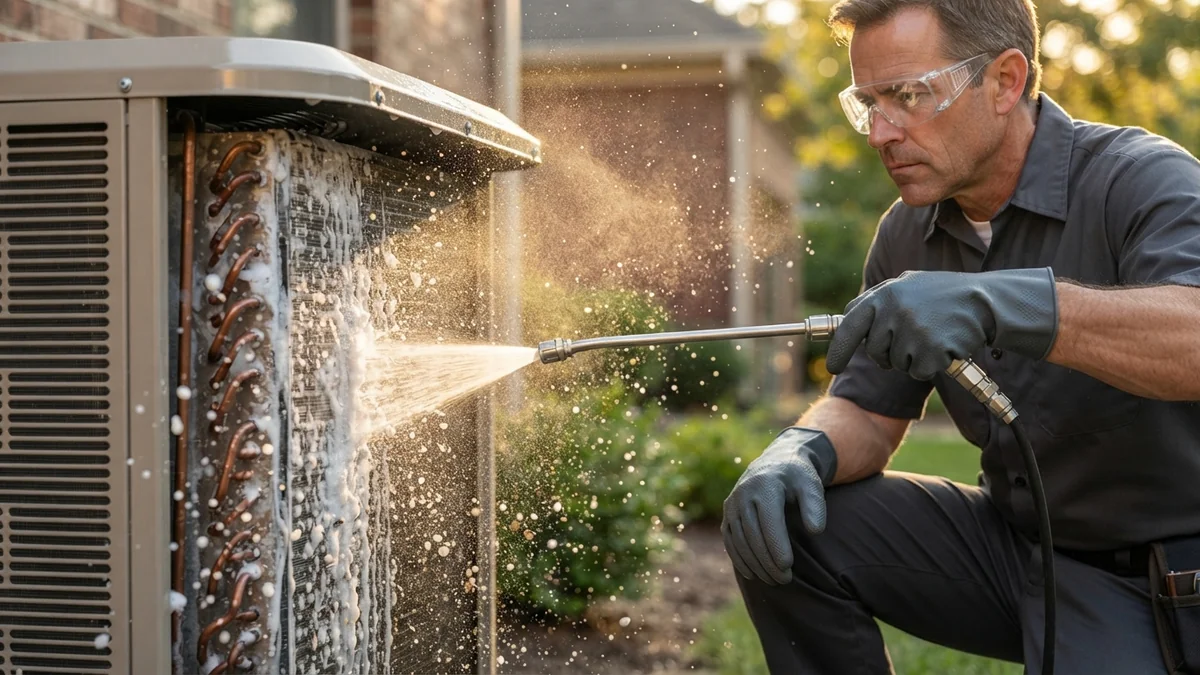
Preventive HVAC maintenance is not a superficial visual check. Our professional technicians conduct comprehensive empirical testing: chemically dissolving baked-on dirt from outdoor condenser coils, tightening high-voltage electrical lugs to manufacturer torque ratings, measuring capacitor microfarad health, calibrating refrigerant pressures, and inspecting gas heat exchangers for microscopic fatigue cracks. By catching emerging component wear early, property owners avoid expensive emergency repairs during the hottest July heat waves and coldest January freezes.
Whether you manage an established historic home in Potwin Place or a modern residence in Westboro, our local dispatch coordinator connects you directly with technicians dedicated to maximizing your heating and cooling efficiency.
Why Routine Preventive HVAC Maintenance Is Essential in Kansas
Northeast Kansas presents a particularly harsh operational climate characterized by mixed-humid conditions, severe prairie winds, and agricultural dust. Neglecting routine maintenance triggers cascading mechanical failures throughout your equipment:
1. Preserving Manufacturer Warranty Compliance
All major HVAC equipment manufacturers (including Carrier, Trane, Lennox, Rheem, and Goodman) explicitly state in their warranty documentation that the 5-year or 10-year parts warranty is conditional upon regular, documented professional maintenance. If a major component like a compressor or heat exchanger fails, manufacturers routinely request proof of annual service before honoring warranty claims. Our itemized maintenance documentation provides the official record required to protect your warranty.
2. Slashing Monthly Evergy Electric and Kansas Gas Bills
Over the course of a single cooling season, airborne dirt and organic debris accumulate between the delicate aluminum fins of your outdoor condenser coil. A mere 0.042-inch layer of dirt on a coil reduces heat transfer efficiency by over 20 percent. This forces the compressor to run under elevated head pressures and pull excessive electrical amperage, causing summer electric bills from Evergy to surge. Regular chemical coil washing restores factory heat rejection, keeping operating costs low.
3. Eliminating Catastrophic Mid-Season Breakdowns
Over 85 percent of all catastrophic heating and cooling failures—including seized compressor pumps, burnt blower motor windings, and cracked heat exchangers—are entirely preventable through proactive maintenance. A weakening dual-run capacitor or loose electrical wire terminal will rarely fail gradually; it will fail during peak load conditions when the system is working hardest. Annual testing identifies and replaces weak components before they leave your home without heat or cooling.
4. Extending Equipment Lifespan by Five to Seven Years
The average replacement cost of a modern central air conditioner or furnace represents a substantial capital investment. Unmaintained systems typically suffer fatal mechanical failure between 10 and 12 years of age. Systems that receive regular seasonal maintenance routinely operate reliably for 16 to 20 years, effectively deferring tens of thousands of dollars in premature replacement expenses.
5. Safeguarding Life and Property From Combustion Hazards
Natural gas furnaces burn combustible fuel supplied by Kansas Gas Service. Incomplete combustion, improperly calibrated gas valves, or cracked heat exchangers release deadly carbon monoxide into indoor living spaces. Annual combustion analysis verifies that your furnace operates safely, vents cleanly through the flue, and maintains proper safety limit switch operation.
The 21-Point Empirical HVAC Maintenance Checklist
Our technicians execute an exhaustive, multi-point maintenance protocol divided into seasonal cooling and heating disciplines:
[Electrical System and Capacitor Health Analysis]
                        │
                        ▼
[Outdoor Condenser Chemical Foaming Wash]
                        │
                        ▼
[Refrigerant Pressure, Superheat and Subcooling Test]
                        │
                        ▼
[Indoor Evaporator Coil Sanitization and Drain Flush]
                        │
                        ▼
[Blower Motor Static Pressure and CFM Measurement]
                        │
                        ▼
[Electronic Combustion and Flue Draft Safety Inspection]
                        │
                        ▼
[Thermostat Calibration and Safety Interlock Clearance]
Spring Air Conditioning Maintenance (Cooling Season)
- Chemical Wash of Outdoor Condenser Coils: Technicians apply professional-grade, non-acidic foaming detergent to penetrate deep within the coil matrix, dissolving baked-on dirt, grass clippings, and cottonwood fuzz before rinsing with low-pressure water.
- Capacitor Microfarad (MFD) Testing: Digital multimeters evaluate compressor and fan motor run capacitors against factory tolerances. Capacitors showing greater than 6 percent degradation are flagged for replacement.
- Contactor Points and Electrical Terminations: Inspecting contactor points for electrical arcing, carbon pitting, and mechanical binding. Tightening all high-voltage electrical lugs to manufacturer inch-pound torque specifications.
- Refrigerant Charge and Subcooling Verification: Connecting digital manifold gauges with temperature clamps to measure liquid subcooling on TXV systems and suction superheat on fixed orifice systems.
- Condensate Drain Line Chemical Flush and Trap Clearing: Clearing the primary and secondary condensate drain lines using high-pressure nitrogen sweeps and sanitizing P-traps to eliminate biological slime and prevent summer drain overflows.
- Condensate Safety Float Switch Testing: Manually testing secondary overflow switches to confirm that the system cuts power to the condensing unit if the drain line ever backs up.
- Outdoor Fan Motor Amp Draw and Blade Balance: Measuring motor operating amperage against Nameplate Full Load Amps (FLA) and checking fan blades for mechanical imbalance or bent pitch.
- Compressor Contactor Voltage Drop and Amp Draw: Measuring operating amps during compressor startup (LRA) and continuous operation (RLA) to detect early winding stress.
- Indoor Evaporator Coil Inspection: Inspecting the indoor coil for bio-film accumulation, restricted airflow, or early signs of formicary copper corrosion.
- Air Filter Replacement or Sanitization: Inspecting air filter condition, replacing disposable 1-inch to 4-inch media filters, or inspecting washable electronic air cleaner cells.
Autumn Heating and Furnace Maintenance (Heating Season)
- Electronic Combustion Analysis and Flue Gas Testing: Inserting an electronic combustion analyzer into the exhaust flue to measure parts-per-million (PPM) of carbon monoxide, oxygen percentage, stack temperature, and combustion efficiency.
- Borescope Heat Exchanger Inspection: Using high-definition articulating cameras to inspect all internal clamshell or tubular heat exchanger passes for micro-fractures, rust perforation, or cracked weld joints.
- Flame Sensor Cleaning and Microamp Testing: Removing the flame rectification sensor, polishing the probe with non-abrasive media to remove silica coating, and verifying strong microamp DC signal strength.
- Hot Surface Igniter Resistance (Ohms) Measurement: Testing electrical resistance across the igniter element to detect thermal micro-fractures prior to complete burnout.
- Draft Inducer Motor Draft Pressure Testing: Connecting digital manometers to test negative static draft pressure across safety pressure switches, ensuring positive mechanical venting.
- Gas Valve Manifold Pressure Calibration: Testing and adjusting natural gas manifold pressure to factory specifications (typically 3.5 inches water column) to prevent under-firing or over-firing.
- Burner Port Cleaning and Alignment: Removing dust and rust debris from primary burner ports to guarantee smooth, quiet flame ignition and prevent delayed ignition banging.
- High-Temperature Limit Switch Verification: Testing safety high-limit switches to confirm the gas valve closes immediately if the furnace cabinet exceeds safe thermal baselines.
- Blower Motor and Squirrel-Cage Wheel Inspection: Checking blower motor amperage, testing run capacitors, and inspecting the squirrel-cage wheel for dust accumulation that restricts CFM airflow.
- Static Duct Pressure (TESP) Testing: Measuring total external static pressure across the return and supply plenums to verify that air delivery matches equipment engineering tables.
- Thermostat Calibration and Operational Sequencing: Testing thermostat heat and cool anticipators, confirming proper relay switching, and calibrating temperature sensors.
Seasonal Maintenance Comparison: Cooling vs Heating
| Maintenance Parameter | Spring Cooling Tune-Up | Autumn Heating Tune-Up |
|---|---|---|
| Primary System Focus | Outdoor condenser, refrigerant pressures, subcooling | Furnace combustion, burners, heat exchanger safety |
| Critical Safety Check | Condensate overflow switch and high-pressure cutout | Carbon monoxide testing and negative flue draft |
| Airflow Objective | Prevent frozen coils and high head pressure | Prevent furnace high-limit overheating and heat exchanger cracking |
| Electrical Focus | Dual-run capacitor MFD and contactor points | Igniter resistance and flame rectification microamps |
| Recommended Timing | March through May (Before extreme heat) | September through November (Before first hard freeze) |
Clean-Tech Protocols and Transparent Service Reporting
When you schedule seasonal maintenance with our network, you receive professional trade service performed with clean-tech property respect:
Sanitized Shoe Covers and Workspace Protection
Our technicians slip on clean, sanitized protective shoe covers before crossing your doorway. Work areas around indoor furnaces and air handlers are protected with heavy canvas floor cloths.
Detailed Written Inspection Scorecard
Upon completion of the 21-point inspection, the technician provides an itemized written maintenance scorecard detailing all measured values: capacitor microfarads, refrigerant subcooling, static duct pressures, and combustion carbon monoxide PPM. If emerging component wear is discovered, you receive an itemized project estimate for your review prior to authorizing any repairs.
Connecting Maintenance With Comprehensive Home Comfort
Routine maintenance serves as the foundation for your property's entire comfort ecosystem:
- If maintenance reveals an irreparable compressor or cracked heat exchanger, explore modern air conditioning installation and replacement or furnace and heating repair options.
- For year-round reversible efficiency, learn about our specialized heat pump services.
- Improve indoor air quality and reduce coil dust accumulation with whole-home filtration and dehumidification.
- Eliminate duct leaks that pull unconditioned attic air into your system with ductwork repair and sealing.
- When unexpected mechanical breakdowns occur, rely on our priority emergency HVAC dispatch.
We proudly provide seasonal maintenance services throughout Shawnee County, including Silver Lake, Auburn, Tecumseh, and neighborhood communities such as College Hill and Sherwood Lake.
Frequently Asked Questions About HVAC Maintenance in Topeka
How often should my HVAC system be maintained?
HVAC systems should receive professional maintenance twice per year: an air conditioning tune-up in the spring (March to May) and a furnace or heating tune-up in the autumn (September to November). Heat pump systems, which operate year-round, also require semi-annual service.
Does regular maintenance really lower my Evergy electric bills?
Yes. Independent studies by the Department of Energy confirm that dirty condenser coils, improperly charged refrigerant, and restricted airflow increase energy consumption by 15 to 25 percent. Restoring factory operating parameters directly lowers monthly utility costs.
What happens if I skip furnace maintenance for a few years?
Skipping furnace maintenance allows dust to accumulate on burners and flame sensors, leading to unexpected winter lockouts. More critically, uninspected heat exchangers can develop microscopic cracks from thermal fatigue, leaking toxic carbon monoxide into your home without warning.
How long does a complete 21-point maintenance inspection take?
A comprehensive seasonal tune-up typically takes between 60 and 90 minutes per system. Our technicians take the time required to perform thorough chemical coil cleaning, complete electrical testing, and safety evaluations.
Schedule Your Seasonal HVAC Tune-Up in Topeka Today
Protect your heating and cooling equipment before seasonal weather extremes strike Shawnee County. Contact our friendly dispatch team today at (785) 219-8054 or submit an online request through our contact page. Experience the peace of mind that comes with thorough 21-point maintenance, clear project estimates, and clean-tech property respect across Topeka, KS.
Mandatory Pricing Disclosure: Estimates are for budgeting purposes only. Actual prices vary based on on-site equipment conditions, ductwork configuration, electrical compatibility, and mechanical permit fees required by the City of Topeka.
Direct Field Dispatch
Need immediate diagnostic assessment or repair scheduling?
Complementary HVAC Services
Our 4-Step Service Methodology
Engineered to guarantee punctuality, upfront cost clarity, and City of Topeka mechanical code compliance.
Discovery and Dispatch
Direct telephone intake with our Topeka dispatch coordinator to document failure symptoms, evaluate weather safety risks, and route the nearest field unit.
Empirical Diagnostic
Comprehensive physical, thermal, and electrical diagnostic testing of coils, motors, capacitors, and gas valves to pinpoint root failures without guesswork.
Clear Upfront Estimate
We explain exact component failure findings and present an itemized written estimate detailing scope and materials for your authorization before work starts.
Precision Execution
Precision repairs using OEM-spec parts, adherence to local Kansas mechanical codes, complete clean-tech vacuum cleanup, and operational clearance sign-off.
Frequently Asked Questions
Clear, factual answers regarding diagnostic procedures, pricing transparency, permits, and equipment performance in Topeka, KS.
How quickly can an HVAC technician be dispatched to my property in Topeka?
Do you provide written estimates before beginning repair work?
What clean-tech property protections do your technicians follow?
Are permits required for HVAC replacement in Topeka, KS?
What is the difference between SEER and SEER2 ratings in Kansas?
Should I repair or replace my aging central air conditioner or furnace?
How do extreme Kansas winter seasons affect heat pump performance?
Do you service both residential and commercial HVAC systems in Shawnee County?
Topeka and Shawnee County Service Radius
Providing direct technician dispatch across regional cities, historic neighborhoods, and rural acreage communities.