AC Repair in Topeka, KS
Rapid diagnostic troubleshooting and precision repair for failing central air conditioners, refrigerant leaks, compressor failures, and electrical faults in Topeka.
Key Service Takeaways • AC Repair
Reliable Air Conditioning Repair Solutions Across Topeka, Kansas
When summer temperatures in northeast Kansas surge into the high 90s accompanied by oppressive humidity, a functioning central air conditioning system is essential for household safety and indoor livability. A cooling breakdown during a heat advisory transforms a comfortable home into an intolerable environment within hours. As part of our comprehensive residential and commercial HVAC services, our field network provides prompt diagnostic dispatch, empirical system evaluations, and precision craftsmanship across Topeka, Shawnee County, and neighboring communities.
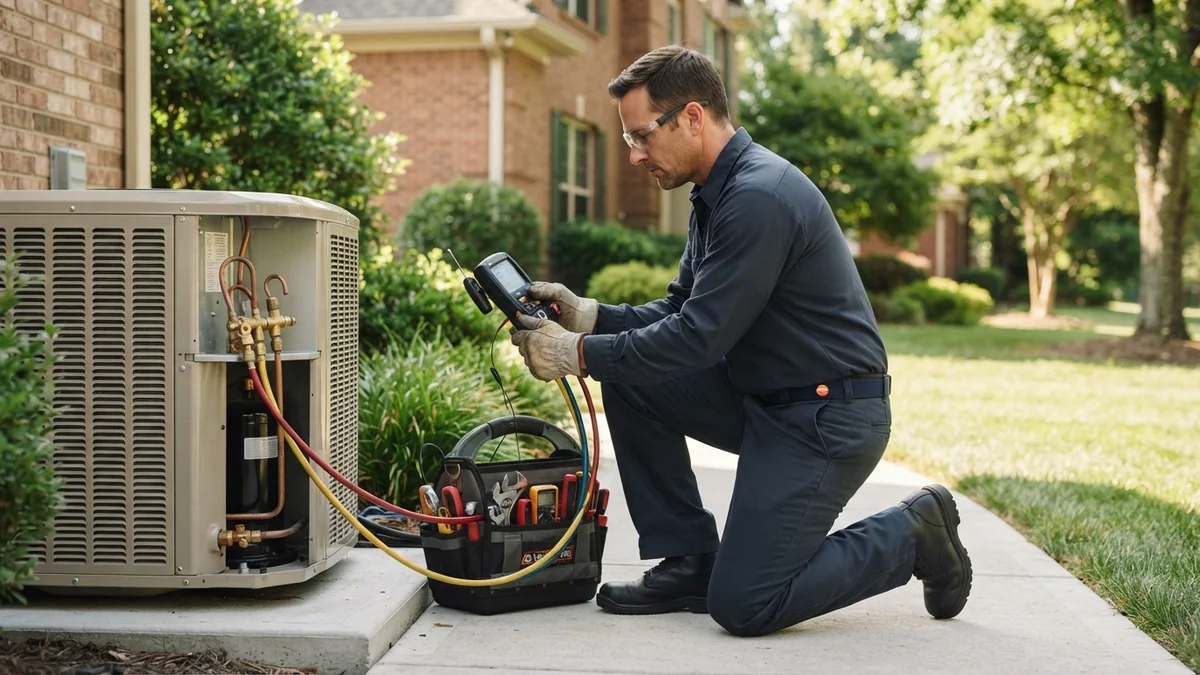
Air conditioning equipment operates under continuous mechanical stress, elevated operating pressures, and significant thermal expansion. When an outdoor condensing unit or indoor air handler exhibits operational abnormalities—such as blowing lukewarm air, short-cycling every few minutes, or producing sharp buzzing sounds—continuing to run the system risks catastrophic component failure. Our professional technicians arrive equipped with advanced digital diagnostic instrumentation, thermal imaging sensors, and common OEM replacement components to restore safe, efficient cooling quickly and cleanly.
Whether your property is located near the historic streets of Potwin Place or within newer developments in Sherwood Lake, our local dispatch coordinator connects you directly with technicians trained to diagnose and repair all major brands and configurations of central cooling equipment.
Warning Signs That Your Topeka AC Requires Immediate Service
Air conditioning systems rarely fail without providing preliminary warning symptoms. Recognizing these operational warning signs enables homeowners to schedule timely intervention before minor component wear causes compressor burnout:
1. Warm or Lukewarm Air Discharging From Supply Vents
If your thermostat is set firmly to COOL and the indoor blower is circulating air, but registers discharge room-temperature or warm air, the refrigeration cycle has collapsed. Potential causes include a failed dual-run capacitor preventing the outdoor compressor from starting, low refrigerant charge resulting from copper tubing corrosion, or a tripped high-pressure safety cutout. Review our detailed troubleshooting guide on AC blowing warm air to inspect basic thermostat and filter settings.
2. Frozen Suction Lines and Evaporator Coils
Discovering a layer of frost or solid ice coating the insulated copper suction line running into your outdoor unit or covering the indoor evaporator coil indicates a severe thermodynamic restriction. Ice formation typically stems from one of two issues: severe airflow starvation caused by heavily blocked air filters and collapsed flex ductwork, or critically low refrigerant pressure that drops coil temperatures below the freezing point of water. Operating a frozen system forces liquid refrigerant into the compressor pump, causing fatal mechanical damage.
3. Rapid Short-Cycling Cycles
A standard central air conditioning system should run for fifteen to twenty minutes per cycle to adequately extract latent moisture from indoor air. If your condensing unit turns on, runs for two to three minutes, and abruptly shuts down only to restart moments later, it is short-cycling. This behavior points to an overheating compressor, an oversized unit, a faulty high-pressure safety switch, or a defective thermostat heat anticipator circuit.
4. Unusual Mechanical and Electrical Noises
Air conditioning systems should operate with a steady, unobtrusive hum. Abrupt noises demand immediate investigation:
- Sharp Screeching or Squealing: Worn bearings in the outdoor condenser fan motor or indoor blower motor assembly.
- Loud Clanking or Rattling: Loose motor mounts, an unbalanced condenser fan blade striking the safety grille, or broken internal compressor valves.
- Continuous Electrical Buzzing or Humming: An electrical contactor chattering due to pitted points, or a compressor motor struggling to turn against a failed start capacitor.
- Hissing or Bubbling Sounds: High-pressure refrigerant escaping through a punctured coil or cracked braze joint.
5. Water Pooling Around the Indoor Air Handler
High summer humidity in Topeka forces evaporator coils to condense dozens of pints of moisture daily. This water drains into an internal collection pan and exits through a PVC condensate line. If algae, mold, or sediment clogs the drain trap, water backs up and overflows the pan, triggering secondary float safety switches or causing ceiling and flooring water damage.
Comprehensive Diagnostic Workflow: How Our Technicians Isolate Faults
We reject guesswork and superficial visual inspections. When our field technicians arrive at your Topeka residence, they execute an empirical, seven-step diagnostic protocol designed to evaluate the physical, electrical, and thermodynamic health of your cooling equipment:
[System Intake and Symptoms Verification]
               │
               ▼
[High and Low Voltage Electrical Testing]
               │
               ▼
[Refrigerant Pressure and Superheat/Subcooling Analysis]
               │
               ▼
[Airflow CFM and Static Duct Pressure Measurement]
               │
               ▼
[Condensate Drainage and Safety Switch Clearance]
               │
               ▼
[Itemized Written Estimate Presentation]
               │
               ▼
[Precision Component Repair and Operational Verification]
Step 1: Electrical System and Component Analysis
Technicians disconnect high-voltage power at the outdoor disconnect box to perform electrical bench testing:
- Capacitor Microfarad (MFD) Testing: Digital multimeters measure the actual capacitance of the dual-run capacitor against rated tolerances (e.g., 45/5 MFD ± 6%). Capacitors operating below specification are replaced before they overheat motor windings.
- Contactor Point Inspection: Contactors are inspected for carbon pitting, copper oxidation, and mechanical binding. Contact resistance is measured across closed poles.
- Motor Winding Resistance: Technicians test compressor start, run, and common windings for electrical continuity and resistance to ground to rule out shorted or grounded motor windings.
Step 2: Thermodynamic Refrigerant Testing
Using digital manifold gauges with temperature pipe clamps, technicians measure real-time suction and liquid line pressures alongside line temperatures:
- Subcooling Evaluation: On systems utilizing a thermostatic expansion valve (TXV), liquid subcooling indicates whether the system possesses the precise factory refrigerant charge.
- Superheat Evaluation: On systems utilizing fixed piston orifices, suction line superheat confirms whether liquid refrigerant is fully boiling off inside the evaporator coil, protecting the compressor from liquid slugging.
- Electronic Leak Detection: If pressures indicate low charge, technicians use heated-diode halogen leak detectors and ultrasonic acoustic sensors across coil joints to pinpoint the leak source before proposing repairs.
Step 3: Airflow and Static Pressure Verification
Airflow directly influences cooling performance. Technicians measure total external static pressure (TESP) across the supply and return plenums using a dual-port digital manometer. High static pressure (exceeding 0.80 inches water gauge) signals restricted ductwork, dirty coils, or an incorrectly matched blower motor speed tap.
Common AC Component Repairs and Replacement Solutions
Our service vehicles carry an extensive inventory of universal and OEM replacement components, enabling most repairs to be completed during the initial dispatch visit:
| Malfunctioning Component | Typical Failure Symptoms | Technical Remediation Procedure |
|---|---|---|
| Dual-Run Capacitor | Outdoor fan spins slowly, compressor hums loudly, system trips breaker on startup | Discharging legacy capacitor, installing OEM-rated high-temperature run capacitor, verifying operating microfarads |
| Outdoor Contactor | Outdoor unit runs continuously, or refuses to start despite thermostat call | Removing pitted contactor, installing sealed 30A or 40A contactor with protective bug shield |
| Condenser Fan Motor | Outdoor fan motor overheats, stops spinning, compressor shuts down on thermal overload | Replacing failed motor with OEM or multi-horsepower rescue motor, balancing fan blade |
| Condensate Float Switch | Entire cooling system shuts off unexpectedly; water detected in drain pan | Clearing condensate line with nitrogen sweep, flushing P-trap with sanitizing wash, resetting safety switch |
| Thermostatic Expansion Valve (TXV) | Erratic superheat, frozen indoor coil, very high suction pressure | Reclaiming refrigerant, unbrazing defective TXV, brazing replacement with nitrogen purge, deep vacuum evacuation to 500 microns |
| Refrigerant Line Leak | Gradual loss of cooling capacity over weeks, oily residue on copper joints | Pressure testing with dry nitrogen at 300 PSI, brazing copper joint with 15% silver alloy, recharging system |
Repair Versus Replacement: Navigating the 5,000 Dollar Decision Rule
When facing significant repair proposals on older equipment, homeowners must evaluate whether ongoing repairs remain financially prudent compared to investing in a modern, high-efficiency system. Our technicians provide unbiased guidance to help you make an informed decision:
- The 5,000 Dollar Industry Rule: Multiply the age of your air conditioning equipment (in years) by the total estimated repair cost (in dollars). If the product exceeds $5,000, replacement is generally the more economical path. For example, a 12-year-old system requiring a $650 blower repair yields 7,800, strongly indicating that replacement offers superior long-term value.
- Refrigerant Type (R-22 vs R-410A vs R-454B): If your system was manufactured prior to 2010, it likely operates on R-22 chlorofluorocarbon refrigerant, which has been fully phased out by the EPA. Sourcing virgin R-22 is exceptionally expensive. Investing substantial funds into repairing an R-22 system is rarely justifiable.
- Compressor Failure: A failed compressor is the single most expensive mechanical repair on an air conditioner. On systems over ten years old with expired manufacturer warranties, compressor replacement is virtually never recommended; investing those funds toward AC installation and replacement secures modern SEER2 efficiency and a new 10-year parts warranty.
Review our transparent AC repair cost guide to examine local Topeka component pricing benchmarks and diagnostic fee structures.
Clear Project Estimates and Clean-Tech Property Protocols
We believe homeowners deserve complete respect and pricing transparency throughout the service experience:
Prior Written Authorization
Our technicians will never perform work without your explicit prior authorization. Once diagnostic testing reveals the root failure cause, you receive an itemized, clear project estimate detailing parts, labor hours, and total cost. What you approve is what you pay—no surprise add-on charges or unverified fees.
Clean-Tech Property Protection
We treat your property with the utmost care. Before entering your home, technicians slip on sanitized protective shoe covers. Heavy canvas drop cloths are positioned beneath indoor air handlers and furnace work areas. When work is completed, technicians vacuum the workspace, remove all spent parts and packaging, and provide complete documentation for your records.
Connecting AC Repair With Comprehensive HVAC Health
An air conditioning breakdown often highlights broader mechanical conditions within the property. When our technicians diagnose a cooling fault, they also evaluate related components that impact system reliability:
- Routine seasonal maintenance helps prevent premature capacitor breakdown and coil fouling; explore our HVAC maintenance and tune-up program.
- If high humidity accompanies your cooling issues, discover how indoor air quality and central dehumidification protects your living spaces.
- Unequal temperatures between rooms often stem from distribution losses; learn how ductwork repair and sealing restores balanced airflow.
- For commercial property managers facing rooftop packaged unit breakdowns, review our specialized commercial HVAC solutions.
We proudly provide prompt local dispatch across all Shawnee County jurisdictions, including municipal hubs like Silver Lake, Auburn, Tecumseh, and neighborhood communities such as College Hill and Westboro.
Frequently Asked Questions About AC Repair in Topeka
How quickly can a technician arrive at my home for AC repair?
Our local dispatch coordinators route technicians throughout Topeka and Shawnee County based on proximity and urgency. During extreme summer heat waves, high-urgency cooling outages are prioritized, with technicians typically arriving promptly within established appointment windows.
What causes an air conditioner to freeze into a block of ice?
An air conditioner freezes primarily due to severe airflow restriction (such as a dirty filter or crushed duct) or low refrigerant levels resulting from a leak. In both cases, the evaporator coil cannot absorb sufficient thermal energy, causing coil surface temperatures to drop below 32 degrees Fahrenheit, freezing ambient moisture into ice.
How much does typical AC repair cost in Topeka?
Minor repairs such as capacitor replacements or condensate line clearing typically range from $150 to $350. Moderate repairs including fan motor replacements or contactor changes range from $300 to $650. Major repairs like coil replacements or leak repairs range higher. For detailed local pricing, review our AC repair cost breakdown.
Is it normal for my outdoor AC unit to make a buzzing noise?
A faint electrical hum is normal, but a loud, continuous buzzing sound often points to an electrical contactor chattering, a defective capacitor, or a compressor motor that is locked and attempting to start. Turn the system off and schedule diagnostic inspection to prevent motor damage.
Schedule Professional AC Repair in Topeka Today
Do not allow a failing air conditioner to compromise your family's comfort and safety during the Kansas summer. Contact our experienced dispatch team today at (785) 219-8054 or submit an online service request through our contact page. We deliver prompt local dispatch, clear project estimates, and clean-tech craftsmanship across Topeka.
Mandatory Pricing Disclosure: Estimates are for budgeting purposes only. Actual prices vary based on on-site equipment conditions, ductwork configuration, electrical compatibility, and mechanical permit fees required by the City of Topeka.
Direct Field Dispatch
Need immediate diagnostic assessment or repair scheduling?
Complementary HVAC Services
Our 4-Step Service Methodology
Engineered to guarantee punctuality, upfront cost clarity, and City of Topeka mechanical code compliance.
Discovery and Dispatch
Direct telephone intake with our Topeka dispatch coordinator to document failure symptoms, evaluate weather safety risks, and route the nearest field unit.
Empirical Diagnostic
Comprehensive physical, thermal, and electrical diagnostic testing of coils, motors, capacitors, and gas valves to pinpoint root failures without guesswork.
Clear Upfront Estimate
We explain exact component failure findings and present an itemized written estimate detailing scope and materials for your authorization before work starts.
Precision Execution
Precision repairs using OEM-spec parts, adherence to local Kansas mechanical codes, complete clean-tech vacuum cleanup, and operational clearance sign-off.
Frequently Asked Questions
Clear, factual answers regarding diagnostic procedures, pricing transparency, permits, and equipment performance in Topeka, KS.
How quickly can an HVAC technician be dispatched to my property in Topeka?
Do you provide written estimates before beginning repair work?
What clean-tech property protections do your technicians follow?
Are permits required for HVAC replacement in Topeka, KS?
What is the difference between SEER and SEER2 ratings in Kansas?
Should I repair or replace my aging central air conditioner or furnace?
How do extreme Kansas winter seasons affect heat pump performance?
Do you service both residential and commercial HVAC systems in Shawnee County?
Topeka and Shawnee County Service Radius
Providing direct technician dispatch across regional cities, historic neighborhoods, and rural acreage communities.