Commercial HVAC Services in Topeka, KS
Light commercial packaged rooftop units (RTU), split systems, economizer controls, and scheduled preventive maintenance agreements across Shawnee County.
Key Service Takeaways • Commercial HVAC Services
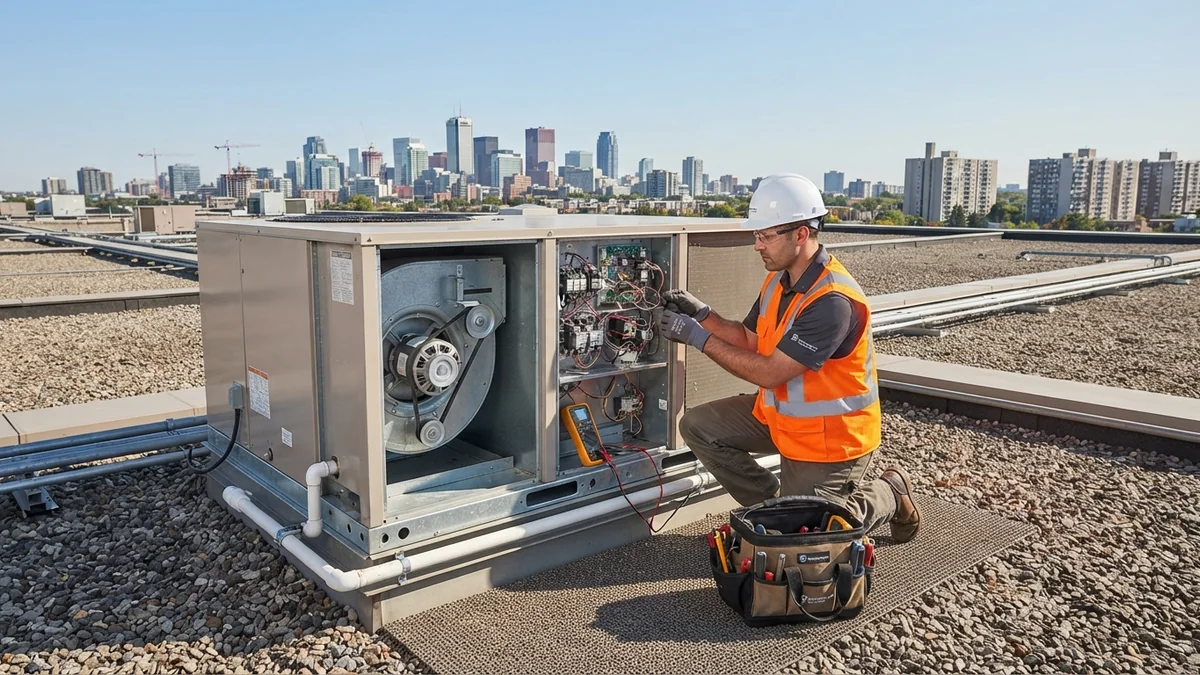
Dependable Light Commercial HVAC Solutions in Topeka, Kansas
For commercial enterprises, medical offices, retail storefronts, and municipal facilities across Topeka and Shawnee County, uninterrupted heating, ventilation, and air conditioning is directly linked to operational productivity, customer satisfaction, and revenue generation. An HVAC outage during business hours does not merely create discomfort; it can force retail closures, ruin temperature-sensitive inventory, compromise computer server rooms, and violate workplace occupational health standards. As part of our comprehensive residential and commercial HVAC services, our field network delivers specialized light commercial mechanical support—including packaged rooftop unit (RTU) repairs, economizer calibration, custom commercial maintenance agreements, and planned system replacements across northeast Kansas.
Commercial mechanical systems operate under significantly higher cooling loads, extended duty cycles, and more complex fresh-air ventilation mandates than residential equipment. Packaged rooftop units must integrate mechanical refrigeration, gas heating, power exhaust fans, and motorized outdoor air economizers governed by ASHRAE Standard 62.1 ventilation guidelines. Our professional technicians possess the specialized commercial diagnostic tooling, crane rigging experience, and 460-volt three-phase electrical knowledge required to service, repair, and maintain commercial systems up to 25 tons.
Whether you operate a commercial property along Wanamaker Road, a professional firm in downtown Topeka, or an enterprise facility in Silver Lake, our local dispatch coordinator connects you directly with technicians dedicated to minimizing downtime with clear project estimates and prompt response times.
Commercial Mechanical Systems Serviced Across Topeka
Our field crews service all major configurations of light commercial HVAC equipment across retail, office, and light industrial facilities:
1. Packaged Rooftop Units (RTUs) From 3 to 25 Tons
Packaged rooftop units represent the primary mechanical workhorse for commercial single-story facilities. Combining the compressor, condenser, evaporator coil, blower fan, and natural gas heat exchanger within a single weather-tight exterior cabinet, RTUs save interior floor space while delivering high-capacity climate control. Our technicians service, troubleshoot, and replace RTUs across all major commercial manufacturers, including Carrier, Trane, Lennox Commercial, York, and Daikin.
2. Commercial Split Systems and Multi-Zone Systems
Many multi-story office buildings, historic properties, and professional suites utilize commercial split systems featuring outdoor condensing units connected to indoor air handlers or multi-zone variable refrigerant flow (VRF) technology. We balance refrigerant distribution, service electronic expansion valves, and calibrate central building automation thermostats.
3. Economizers and Outdoor Air Damper Controls
Modern commercial energy codes enforced by the City of Topeka Development Services require motorized economizers on commercial cooling systems. An economizer utilizes outdoor enthalpy sensors and motorized dampers to draw in cool outdoor air when ambient temperatures and humidity drop below set thresholds (e.g., in autumn and spring). This provides "free cooling" without energizing the mechanical compressor, slashing commercial electric bills from Evergy. When enthalpy sensors drift or damper gear actuators seize, units waste energy or pull in humid outdoor air. Our technicians calibrate and repair economizer assemblies to maintain optimal efficiency.
4. Commercial Gas Heating and Unit Heaters
We provide comprehensive troubleshooting and maintenance for commercial gas-fired RTU heat exchangers, direct-spark ignition systems, and overhead suspended gas unit heaters in commercial warehouses, auto repair facilities, and distribution centers supplied through Kansas Gas Service.
Common Commercial HVAC Failure Modes and Field Diagnostics
Commercial equipment operates under continuous commercial hours and heavy occupancy loads. Recognizing failure symptoms early enables facility managers to address faults before operational shutdown occurs:
| Failure Symptom | Underlying Commercial Fault | Technical Remediation Procedure |
|---|---|---|
| Complete cooling loss across commercial retail zone | Tripped 3-phase compressor breaker, open high-pressure cutout, failed contactor | Megohmmeter insulation resistance testing, checking phase balance, replacing pitted contactor |
| Occupants complain of stuffy, stale indoor air | Seized economizer damper actuator motor or failed outdoor enthalpy sensor | Testing 0-10V DC actuator modulation signal, freeing mechanical damper linkage, replacing sensor |
| Severe indoor temperature swings and hot spots | Slipping V-belt on blower motor, worn drive pulley, or obstructed return grille | Replacing worn cogged V-belts, aligning motor pulleys, balancing static airflow |
| Water leaking through commercial ceiling acoustic tiles | Clogged rooftop condensate P-trap, rusted internal drain pan, or cracked PVC line | Clearing primary drain lines with high-pressure nitrogen, replacing cracked galvanized drain pan |
| Furnace burner lockout on RTU call for heat | Sooted flame sensor, failed direct-spark ignition module, or open rollout switch | Cleaning ignition probes, verifying microamp rectification, testing gas valve manifold pressure |
Commercial Diagnostic Protocol: Minimizing Business Disruption
When commercial cooling or heating fails, speed and diagnostic accuracy are critical. Our technicians follow a structured commercial diagnostic workflow designed to isolate faults quickly while maintaining safety:
[Commercial Facility Intake and Safety Review]
                     │
                     ▼
[Three-Phase Electrical Voltage and Phase Balance Test]
                     │
                     ▼
[Blower Drive Belt Tension and Motor Amp Draw Check]
                     │
                     ▼
[Refrigeration Circuit Subcooling and Head Pressure Analysis]
                     │
                     ▼
[Economizer Damper Modulation and Enthalpy Sensor Test]
                     │
                     ▼
[Combustion Safety and Heat Exchanger Inspection]
                     │
                     ▼
[Presentation of Itemized Written Repair Estimate]
Step 1: Three-Phase Electrical Analysis
Commercial RTUs commonly operate on 208V, 230V, or 460V three-phase alternating current. Technicians measure line-to-line and line-to-ground voltages to verify voltage balance within 2 percent. Phase imbalance causes excessive winding heat in three-phase compressor motors, leading to premature motor winding burnout.
Step 2: Blower Belt and Airflow Drive Calibration
Unlike residential direct-drive blowers, commercial packaged units frequently use belt-driven squirrel-cage blower fans. Technicians inspect V-belts for cracking, glazing, or slack. Belt tension is measured with a deflection gauge, and motor sheaves are aligned with laser tools to eliminate belt slip and ensure full design CFM air delivery across coils.
Step 3: Dual-Circuit Refrigeration Testing
Commercial units typically incorporate two independent refrigeration circuits (dual tandem compressors) for staged cooling capacity. Technicians connect digital manifold gauges to both circuits simultaneously to compare high-side head pressures, suction pressures, subcooling, and superheat against factory charging charts.
Commercial Preventive Maintenance Agreements (PMA)
Unscheduled equipment failure is the most expensive way to manage commercial HVAC assets. Our Commercial Preventive Maintenance Agreements provide scheduled, quarterly inspections designed to eliminate downtime, lower operating expenses, and extend equipment life:
Quarterly Commercial Inspection Scope
- Quarter 1 (Spring Cooling Startup): Deep chemical foaming wash of outdoor condenser coils, testing dual-run capacitors and contactors, checking refrigerant subcooling, clearing condensate drains, and lubricating blower bearings.
- Quarter 2 (Summer Mid-Season Check): Testing operating amp draws under peak heat loads, inspecting economizer outdoor air dampers, and replacing high-capacity pleated air filters.
- Quarter 3 (Autumn Heating Startup): Electronic combustion analysis, testing natural gas manifold pressure, inspecting heat exchangers with articulating borescopes, cleaning flame sensors, and verifying flue drafting.
- Quarter 4 (Winter Mid-Season Check): Checking belt tension, inspecting economizer minimum position settings to ensure compliance with ASHRAE 62.1 outdoor air standards, and inspecting electrical disconnect enclosures.
Business Benefits of a Custom Maintenance Agreement
- Priority Dispatch Status: Commercial contract holders receive priority dispatch routing during severe weather events.
- Reduced Operating Costs: Clean coils and properly tensioned belts reduce electricity consumption by up to 20 percent.
- Predictable Budgeting: Comprehensive written inspection reports outline emerging equipment wear, allowing facility directors to budget for planned replacements rather than facing emergency capital expenses.
Planned Commercial Rooftop Unit Replacement and Crane Rigging
When commercial RTUs exceed their fifteen-year useful life or suffer fatal compressor burnout, our team coordinates turn-key planned replacements:
- Curb Adapter Engineering: When replacing legacy rooftop units, the new equipment often has a different physical footprint. We design and install custom heavy-gauge curb adapters that transition between the existing roof curb and the new unit without disturbing the roof membrane.
- Licensed Crane Rigging and Permitting: We coordinate certified crane hoisting, street closure permits with the City of Topeka, and weekend or after-hours installation schedules to ensure zero disruption to your daily business operations.
- Municipal Permitting: All commercial mechanical replacements are fully permitted through the City of Topeka Development Services, ensuring full commercial code compliance.
Clean-Tech Protocols and Transparent Project Estimates
We know that commercial operations demand professionalism, safety, and strict accountability:
- Clean-Tech Protocols: Technicians respect your business environment, utilizing protective floor coverings in customer-facing areas and securing all rooftop work zones according to OSHA fall protection guidelines.
- Clear Project Estimates: Prior to starting physical repair work, facility managers receive an itemized, clear written estimate detailing parts, labor hours, and total project investment. What you approve is what you pay—with zero unexpected surcharges.
Connecting Commercial HVAC With Complete Property Comfort
Commercial mechanical systems integrate with broader environmental systems:
- Ensure clean, allergen-free indoor air for employees and customers with advanced indoor air quality solutions.
- Eliminate duct leakage and hot spots across large commercial spaces with ductwork repair and sealing.
- When high-urgency mechanical failure threatens business operations, utilize our priority emergency HVAC dispatch.
- Maintain peak equipment efficiency with our comprehensive HVAC maintenance and tune-up programs.
- Explore energy-efficient all-season alternatives with commercial-grade heat pump services.
We provide complete commercial HVAC services across Topeka and Shawnee County, including Auburn, Tecumseh, and surrounding regional communities.
Frequently Asked Questions About Commercial HVAC in Topeka
How often should commercial rooftop units (RTUs) be serviced?
Commercial RTUs should be serviced at least quarterly (four times per year). High operating hours, commercial kitchen exhaust, and outdoor environmental exposure require regular filter replacements, belt adjustments, and coil cleaning to prevent costly business interruptions.
What is an HVAC economizer, and is it required in Topeka?
An economizer is a motorized damper system that brings in cool outdoor air to provide "free cooling" when weather conditions permit. Under local commercial building codes based on the International Energy Conservation Code (IECC), economizers are legally required on most commercial cooling systems with capacities over 4.5 tons.
Can our commercial RTU be replaced over the weekend to avoid closing our business?
Yes. Our commercial installation team regularly coordinates after-hours, weekend, or holiday crane lifts and equipment change-outs to ensure your business remains open and fully operational without customer disruption.
What causes a three-phase compressor motor to fail prematurely?
The leading cause of commercial three-phase compressor failure is voltage imbalance. If voltage between electrical phases varies by more than 2 percent, motor winding temperatures spike rapidly, breaking down dielectric insulation and causing motor short circuits. Regular electrical maintenance catches phase imbalances before motor failure occurs.
Schedule Commercial HVAC Service in Topeka Today
Protect your business operations, customer comfort, and mechanical equipment with proven commercial HVAC expertise. Contact our commercial dispatch desk today at (785) 219-8054 or submit an inquiry through our contact page. We deliver prompt local dispatch, clear project estimates, and certified craftsmanship across Topeka, KS.
Mandatory Pricing Disclosure: Estimates are for budgeting purposes only. Actual prices vary based on on-site equipment conditions, ductwork configuration, electrical compatibility, and mechanical permit fees required by the City of Topeka.
Direct Field Dispatch
Need immediate diagnostic assessment or repair scheduling?
Complementary HVAC Services
Our 4-Step Service Methodology
Engineered to guarantee punctuality, upfront cost clarity, and City of Topeka mechanical code compliance.
Discovery and Dispatch
Direct telephone intake with our Topeka dispatch coordinator to document failure symptoms, evaluate weather safety risks, and route the nearest field unit.
Empirical Diagnostic
Comprehensive physical, thermal, and electrical diagnostic testing of coils, motors, capacitors, and gas valves to pinpoint root failures without guesswork.
Clear Upfront Estimate
We explain exact component failure findings and present an itemized written estimate detailing scope and materials for your authorization before work starts.
Precision Execution
Precision repairs using OEM-spec parts, adherence to local Kansas mechanical codes, complete clean-tech vacuum cleanup, and operational clearance sign-off.
Frequently Asked Questions
Clear, factual answers regarding diagnostic procedures, pricing transparency, permits, and equipment performance in Topeka, KS.
How quickly can an HVAC technician be dispatched to my property in Topeka?
Do you provide written estimates before beginning repair work?
What clean-tech property protections do your technicians follow?
Are permits required for HVAC replacement in Topeka, KS?
What is the difference between SEER and SEER2 ratings in Kansas?
Should I repair or replace my aging central air conditioner or furnace?
How do extreme Kansas winter seasons affect heat pump performance?
Do you service both residential and commercial HVAC systems in Shawnee County?
Topeka and Shawnee County Service Radius
Providing direct technician dispatch across regional cities, historic neighborhoods, and rural acreage communities.