Emergency HVAC Services in Topeka, KS
Priority field response for severe winter furnace outages, dangerous summer AC shutdowns, water leaks, and electrical burning odors across Shawnee County.
Key Service Takeaways • Emergency HVAC Services
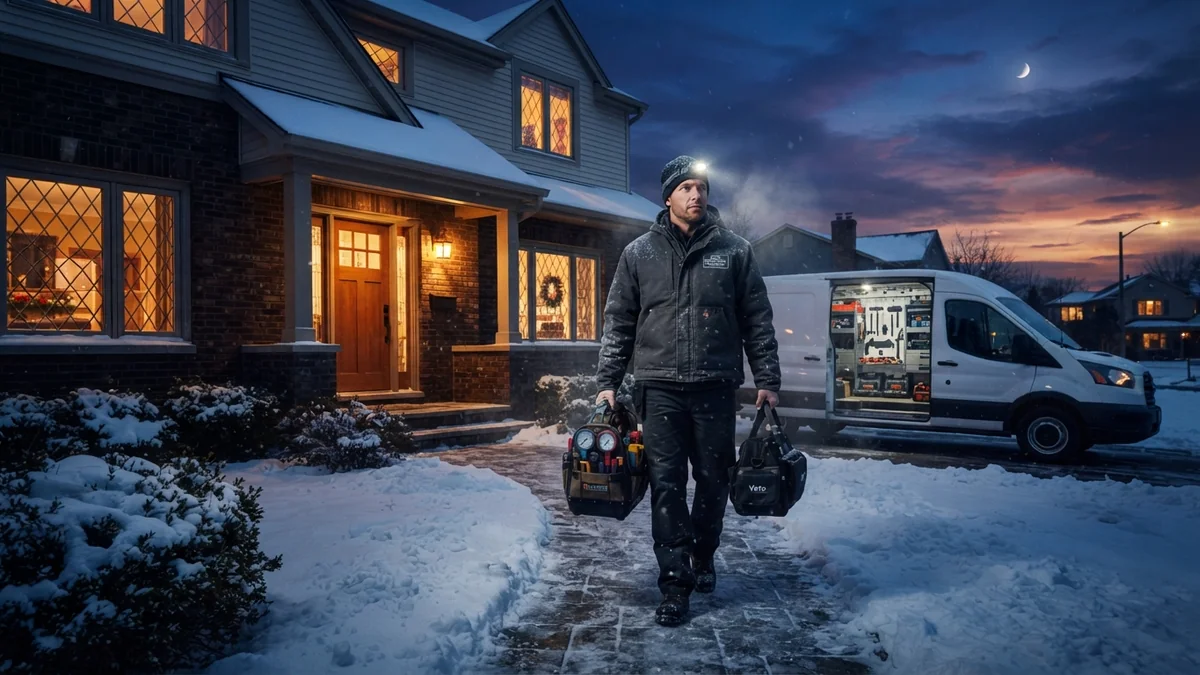
Priority Emergency HVAC Services in Topeka, Kansas
When mechanical heating or cooling systems fail during extreme weather events in northeast Kansas, standard appointment wait times are not an option. In the depths of January when temperatures plummet below zero with dangerous wind chills, a total loss of heat can cause residential water pipes to freeze and burst within twelve hours, causing tens of thousands of dollars in catastrophic structural water damage. Similarly, during peak July and August heat advisories when heat indices surpass 105 degrees, a collapsed air conditioner creates immediate heat exhaustion hazards for elderly family members, infants, and pets. As part of our comprehensive residential and commercial HVAC services, our field network delivers prompt emergency diagnostic dispatch, empirical system assessments, and clear project estimates throughout Topeka and Shawnee County.
Our emergency service protocol connects property owners directly with a local dispatch coordinator who documents system symptoms, evaluates immediate safety risks, and routes the nearest fully equipped field unit. Our service vehicles function as mobile parts warehouses, stocked with heavy-duty dual-run capacitors, universal ignition modules, hot surface igniters, contactors, rescue fan motors, and emergency safety controls. Our goal during an emergency dispatch visit is not merely temporary patch-work, but the safe, code-compliant restoration of your home's heating or cooling infrastructure.
Whether your property is located in an established historic neighborhood like Potwin Place or in rural residential communities near Silver Lake, our response desk stands ready to assist with prompt local routing and transparent communication.
What Constitutes a True HVAC Emergency?
While any heating or air conditioning malfunction causes frustration, certain scenarios represent immediate threats to health, life safety, or structural integrity. We treat the following conditions with maximum dispatch priority:
1. Total Heating Loss During Sub-Freezing Winter Weather
When outdoor temperatures in Topeka drop below 32 degrees Fahrenheit and your furnace or heat pump fails to ignite or produce warm air, indoor temperatures drop rapidly. Once indoor temperatures fall below 50 degrees, water lines located in exterior walls, crawlspaces, and unconditioned basements face acute freezing risk. A burst copper or PEX pipe can flood a home with hundreds of gallons of water per hour. Prompt emergency heating restoration protects your plumbing and prevents structural damage.
2. Complete Air Conditioning Shutdown During Extreme Heat Advisories
During severe summer heat waves, indoor temperatures inside two-story homes and attics can climb well above 90 degrees Fahrenheit within hours of an air conditioning failure. High indoor humidity exacerbates thermal stress, creating dangerous conditions for vulnerable household members, including individuals with respiratory illnesses, cardiovascular conditions, or mobility limitations.
3. Acrid Electrical Burning Odors Emanating From Vents
If you detect a sharp, pungent odor resembling burning plastic, melting rubber, or ozone when the HVAC blower runs, shut the system down immediately. This odor indicates severe electrical overheating—such as melted wire insulation, a failing blower motor winding shorting out, or high-voltage arcing across a pitted contactor. Continuing to operate the system creates an active fire hazard.
4. Continuous Water Pouring From Indoor Air Handler Units
While minor condensation drips are common during humid weather, water actively overflowing drain pans and pouring through ceilings, attic joists, or mechanical closet floors demands immediate emergency intervention. Blocked primary and secondary drain traps can cause substantial ceiling collapse, soaked drywall, and electrical shorts in furnace control boards mounted directly beneath indoor coils.
5. Suspicion of Carbon Monoxide Leakage or Gas Odors
If carbon monoxide alarms sound or you observe yellow, wavering flames inside your furnace combustion chamber accompanied by physical symptoms such as unexplained headaches, dizziness, nausea, or burning eyes among family members, treat the situation as an immediate life-safety emergency.
Critical Safety Protocols: What to Do Before Dispatch Arrives
Taking immediate, calm safety measures before the service technician arrives at your property protects your family and limits mechanical damage:
[Recognize Emergency Failure Symptoms]
                 │
                 ▼
[Identify Safety Category: Combustion / Electrical / Freeze / Water]
                 │
                 ▼
[Execute Immediate Homeowner Safety Protocols]
                 │
                 ▼
[Contact Direct Topeka Field Dispatch Desk]
                 │
                 ▼
[Technician Arrival, Diagnostic Testing and Clear Estimate]
Safety Protocol A: If You Smell Natural Gas
- Evacuate Immediately: Have all occupants and household pets leave the premises immediately. Do not stop to retrieve belongings.
- Do Not Touch Any Electrical Switches: Do not turn lights on or off, do not unplug appliances, and do not use a landline telephone inside the home. An electrical spark from a switch can ignite accumulated natural gas.
- Leave Doors Open Behind You: If safe to do so, leave the front door open to promote air ventilation.
- Call Emergency Services From a Safe Distance: Once outside and well away from the structure, call the Kansas Gas Service Emergency Line or dial 911 immediately.
Safety Protocol B: If Carbon Monoxide Alarms Sound
- Immediately evacuate all household members into fresh outdoor air.
- Dial 911 so local fire emergency personnel can inspect the property with atmospheric gas detectors.
- Once the fire department has cleared the home and red-tagged the heating system, contact our dispatch desk to schedule a comprehensive electronic heat exchanger inspection and furnace heating repair.
Safety Protocol C: If Your Furnace Fails During a Hard Freeze
- Close curtains and blinds across all windows to create an insulating thermal barrier.
- Open cabinet doors beneath kitchen sinks, bathroom vanities, and laundry rooms to allow ambient warm air to circulate around plumbing supply pipes.
- Allow cold water faucets along exterior walls to maintain a slight, continuous pencil-lead trickle to prevent ice crystal formation inside the pipes.
- Review our quick furnace troubleshooting guide to inspect basic thermostat batteries and filter blockages.
Safety Protocol D: If Your AC Fails During a Heat Advisory
- Close all blinds and solar shades on south- and west-facing windows to block radiant solar heat gain.
- Avoid using heat-generating appliances such as ovens, dishwashers, and clothes dryers.
- Run ceiling fans in a counter-clockwise direction to create an evaporative cooling wind-chill effect.
- If ice is visible on the outdoor copper suction line, turn the thermostat to OFF and set the fan switch to ON to begin melting the coil before the technician arrives. Review our troubleshooting guide on AC blowing warm air.
Empirical Emergency Diagnostic Workflow
When our technician arrives at your property during an emergency call, they conduct an organized, step-by-step diagnostic investigation designed to identify the root failure mode without wasting time:
| Diagnostic Stage | Component Focus | Specific Technical Measurement |
|---|---|---|
| Stage 1: Electrical Verification | Disconnect boxes, circuit breakers, fuses | High-voltage supply testing (208/240V), low-voltage transformer output (24V AC) |
| Stage 2: Safety Interlocks | Limit switches, rollout sensors, float switches | Continuity testing across bimetal safety sensors and water level float switches |
| Stage 3: Combustion Testing | Gas valves, draft inducer, igniter, flame sensor | Flue draft pressure (inches w.c.), manifold gas pressure, flame rectification microamps |
| Stage 4: Refrigerant Verification | Compressor windings, line pressures, coils | High/low side pressures, superheat/subcooling values, electronic leak detection |
| Stage 5: Airflow Evaluation | Blower motor, squirrel cage, duct plenums | Total external static pressure (TESP), motor operating amperage against nameplate FLA |
Transparent Emergency Estimates: Zero Predatory Pricing
Experiencing a sudden heating or cooling failure is stressful enough without having to worry about predatory contractor pricing tactics. Our network operates with strict pricing integrity:
Upfront Written Authorization
Our technicians do not begin physical repair work until they have thoroughly diagnosed the problem and presented a clear, itemized written estimate detailing the exact parts required, labor time, and total cost. What you approve on the written proposal is what you pay—with zero surprise add-on charges upon job completion.
No Overtime Penalty Rates
We do not penalize property owners for when equipment decides to fail. Heating and cooling systems do not check the clock before a capacitor blows or a flame sensor oxidizes. Our project estimates reflect transparent, standardized trade pricing regardless of the hour or day.
Clean-Tech Standards During Emergency Service
Even during high-urgency emergency dispatch visits, our professional technicians uphold strict clean-tech property respect:
- Sanitized protective shoe covers are slipped on before stepping across your doorway.
- Heavy canvas drop cloths are placed beneath all mechanical equipment work zones to catch grease, rust, or condensate water.
- After restoring system operation, technicians vacuum the workspace, remove all spent parts and packaging, and provide complete documentation for your records.
Connecting Emergency Repairs With Long-Term System Health
An emergency repair resolves the immediate crisis, but often highlights underlying system conditions that warrant proactive attention:
- After restoring emergency cooling, schedule a comprehensive air conditioning repair and evaluation to address lingering efficiency issues.
- If your system is over 15 years old and experiencing recurring breakdowns, consider upgrading to a high-efficiency system through our AC installation and replacement program.
- Prevent future unexpected outages with our multi-point HVAC maintenance and tune-up program.
- In mild winter weather, discover how heat pump services and dual-fuel systems deliver superior energy resilience.
- For business facilities requiring priority emergency response, review our light commercial HVAC solutions.
We proudly provide prompt emergency dispatch across all Shawnee County jurisdictions, including municipal hubs like Auburn, Tecumseh, and neighborhood communities such as College Hill and Sherwood Lake.
Frequently Asked Questions About Emergency HVAC in Topeka
How quickly can an emergency technician arrive at my home?
Our local dispatch coordinators route technicians throughout Topeka and Shawnee County based on real-time field proximity. High-urgency safety outages (such as freezing home heating losses or extreme heat advisories) receive priority dispatch routing, with technicians typically arriving promptly within agreed appointment windows.
What should I do if my furnace stops working in the middle of a freeze?
First, verify that your thermostat display is active and set firmly to HEAT. Next, check your electrical panel for tripped circuit breakers. If the breakers are intact, open cabinet doors under sinks to protect water pipes, allow a slight trickle of water through exterior faucets, and call our dispatch desk immediately.
Will emergency service cost more than standard service?
Our network provides clear project estimates before any repair work begins. We present an itemized written estimate detailing parts and labor for your approval so you know the exact cost upfront.
Can an emergency technician replace a complete HVAC system during an emergency?
If diagnostic testing reveals an irreparable catastrophic failure (such as a severely cracked heat exchanger or a completely burned-out compressor), our team can stabilize the property with temporary measures (such as safe auxiliary heat) and prioritize the earliest available installation slot for whole-system replacement.
Contact Our Topeka Emergency Dispatch Desk Now
If you are facing an urgent heating or cooling breakdown in Shawnee County, do not wait for the situation to worsen. Connect directly with our local response desk at (785) 219-8054 or submit an online service inquiry through our contact page. Experience the difference of prompt local dispatch, clear project estimates, and clean-tech property respect from Topeka's trusted HVAC service network.
Mandatory Pricing Disclosure: Estimates are for budgeting purposes only. Actual prices vary based on on-site equipment conditions, ductwork configuration, electrical compatibility, and mechanical permit fees required by the City of Topeka.
Direct Field Dispatch
Need immediate diagnostic assessment or repair scheduling?
Complementary HVAC Services
Our 4-Step Service Methodology
Engineered to guarantee punctuality, upfront cost clarity, and City of Topeka mechanical code compliance.
Discovery and Dispatch
Direct telephone intake with our Topeka dispatch coordinator to document failure symptoms, evaluate weather safety risks, and route the nearest field unit.
Empirical Diagnostic
Comprehensive physical, thermal, and electrical diagnostic testing of coils, motors, capacitors, and gas valves to pinpoint root failures without guesswork.
Clear Upfront Estimate
We explain exact component failure findings and present an itemized written estimate detailing scope and materials for your authorization before work starts.
Precision Execution
Precision repairs using OEM-spec parts, adherence to local Kansas mechanical codes, complete clean-tech vacuum cleanup, and operational clearance sign-off.
Frequently Asked Questions
Clear, factual answers regarding diagnostic procedures, pricing transparency, permits, and equipment performance in Topeka, KS.
How quickly can an HVAC technician be dispatched to my property in Topeka?
Do you provide written estimates before beginning repair work?
What clean-tech property protections do your technicians follow?
Are permits required for HVAC replacement in Topeka, KS?
What is the difference between SEER and SEER2 ratings in Kansas?
Should I repair or replace my aging central air conditioner or furnace?
How do extreme Kansas winter seasons affect heat pump performance?
Do you service both residential and commercial HVAC systems in Shawnee County?
Topeka and Shawnee County Service Radius
Providing direct technician dispatch across regional cities, historic neighborhoods, and rural acreage communities.