AC Installation and Replacement in Topeka, KS
Engineered Manual J cooling load calculations, precision duct matching, and high-efficiency SEER2 central air conditioning installation in Shawnee County.
Key Service Takeaways • AC Installation and Replacement
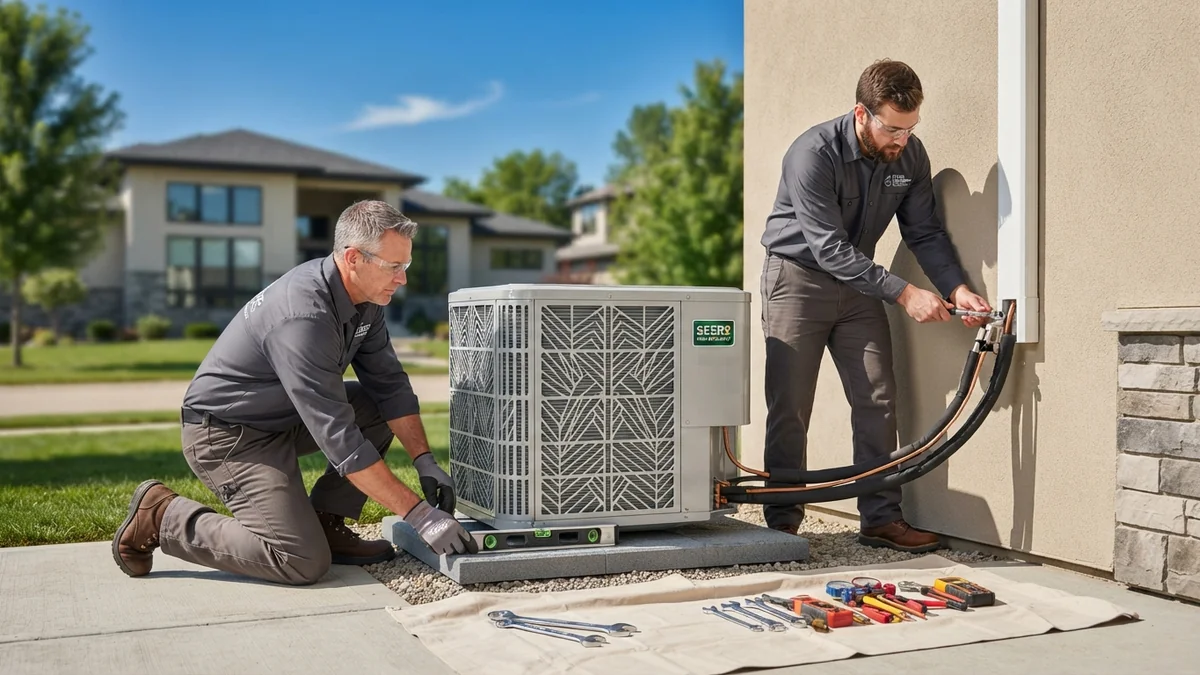
Precision Central Air Conditioning Installation and Replacement in Topeka, KS
Investing in a new central air conditioning system is one of the most significant mechanical investments a homeowner will make in their property. In Topeka, Kansas, where summer temperatures routinely challenge the 100-degree mark with intense humidity, your cooling system cannot simply be an off-the-shelf appliance. It must be an engineered comfort system sized precisely to your home's thermal boundary, matched to your ductwork's static airflow capacity, and installed in strict compliance with regional building codes. As part of our comprehensive residential and commercial HVAC services, our field network delivers meticulous load calculations, high-efficiency SEER2 equipment options, and clean-tech installation standards across Topeka and Shawnee County.
A poorly installed air conditioning system can lose up to 30 percent of its rated efficiency on day one due to improper refrigerant charging, incorrect blower speed configuration, or leaky plenum transitions. Our professional technicians approach every air conditioning installation with engineering rigor. We do not use crude rule-of-thumb square footage estimates. Instead, we execute full ACCA (Air Conditioning Contractors of America) Manual J load calculations to determine the exact sensible and latent cooling requirements of your living space.
Whether you are upgrading an aging, inefficient condensing unit in College Hill or installing a multi-stage comfort system in Sherwood Lake, our local team coordinates every stage of the installation process—from equipment selection to municipal permitting and post-installation airflow testing.
When Is It Time to Replace Your Central Air Conditioner?
Homeowners often struggle to determine whether they should continue investing in air conditioning repairs or replace an aging system. Continuing to nurse a failing air conditioner past its useful lifespan often results in compounding repair bills, elevated monthly electric bills through Evergy, and catastrophic failure during the hottest weeks of summer. Consider replacement when your system exhibits the following criteria:
1. Equipment Age Exceeding 12 to 15 Years
The average operational lifespan of a central air conditioner in northeast Kansas ranges between 12 and 16 years. As equipment crosses the twelve-year mark, internal compressor motor windings degrade, outdoor aluminum fins deteriorate from weather and hail exposure, and electrical components become brittle. Beyond this age, the probability of major mechanical breakdown increases exponentially.
2. Operation on Phased-Out R-22 Refrigerant
If your air conditioning unit was installed prior to 2010, it almost certainly operates on R-22 (Freon). Under EPA Clean Air Act regulations, the production and importation of R-22 have been completely banned. Sourcing reclaimed or recycled R-22 to address minor refrigerant leaks has become prohibitively expensive, often costing hundreds of dollars per pound. Investing significant capital into recharging an aging R-22 system is an inefficient use of funds; modern replacement systems utilize environmentally responsible R-410A or next-generation low-GWP refrigerants such as R-454B.
3. Chronic Mechanical Breakdowns and the 5,000 Dollar Rule
A standard industry guideline for evaluating equipment economics is the $5,000 rule: multiply the age of your cooling system in years by the estimated repair cost in dollars. If the total exceeds 5,000, replacement is the more prudent investment. For example, a 13-year-old system requiring an $800 fan motor and capacitor replacement yields an index of 10,400, well over the threshold. Explore our detailed AC replacement cost guide to compare new equipment investment tiers.
4. Excessive Summer Utility Bills
If your summer electric bills from Evergy have steadily escalated despite consistent thermostat setpoints, your system's seasonal energy efficiency has severely decayed. Older 10 to 12 SEER units consume nearly double the kilowatt-hours of modern 16 to 20+ SEER2 systems, resulting in substantial operating cost differences over the course of a Kansas summer.
5. Inadequate Humidity Extraction and Uneven Room Temperatures
An air conditioner does not merely chill air; it extracts pints of moisture from indoor humidity. If indoor spaces feel clammy, sticky, or upstairs rooms remain stubbornly ten degrees hotter than downstairs living areas, your current system may be oversized, short-cycling, or mismatched to your ductwork. A modern multi-stage or variable-speed system eliminates these comfort disparities.
Understanding the New SEER2 Energy Efficiency Standards in Kansas
In recent years, the Department of Energy enacted mandatory updates to regional cooling efficiency standards, replacing legacy SEER (Seasonal Energy Efficiency Ratio) ratings with SEER2.
What Makes SEER2 Different?
Under legacy SEER testing protocols, air conditioning equipment was evaluated in laboratory settings under unrealistically low external static duct pressure (0.10 inches of water column). In real-world homes, residential duct systems routinely operate under 0.50 inches of static pressure or higher. The updated SEER2 protocol tests equipment under a rigorous 0.50-inch static pressure baseline, representing an approximate 4.5 percent increase in testing resistance.
In Kansas (which falls under the northern regulatory region for split-system air conditioning), all newly installed split-system air conditioners must achieve a minimum of 13.4 SEER2 (equivalent to approximately 14.0 SEER under legacy metrics). High-efficiency models reach between 16.0 and 22.0+ SEER2, providing substantial energy savings and qualifying property owners for local utility rebates.
Equipment Tiers: Choosing the Right Cooling Technology for Your Home
Modern central cooling equipment falls into three distinct mechanical operational tiers. Our technicians evaluate your floor plan, lifestyle preferences, and budget to recommend the optimal match:
| Equipment Operational Tier | Compressor Technology | Efficiency Range | Sound Level (Decibels) | Humidity Control Performance | Best Suited For |
|---|---|---|---|---|---|
| Single-Stage Standard | Operates at 100% capacity whenever called; on or off | 13.4 to 15.2 SEER2 | 72 to 76 dB | Standard dehumidification during long run cycles | Budget-conscious replacements, rental properties, smaller single-story homes |
| Two-Stage Enhanced | Runs at ~65% low capacity on mild days; shifts to 100% on extreme heat days | 15.2 to 18.0 SEER2 | 68 to 72 dB | Superior moisture extraction due to longer, low-speed runtimes | Two-story homes, residences with moderate humidity challenges, established neighborhoods |
| Variable-Speed Inverter | Modulation in 1% increments from 25% to 100% capacity | 18.0 to 22.0+ SEER2 | 54 to 62 dB (Whisper Quiet) | Precision humidity control; maintains target humidity within 2% | Large luxury homes, properties in Sherwood Lake with lake humidity, maximum Evergy bill reduction |
The Engineering Behind ACCA Manual J Load Calculations
The most critical mistake made during air conditioning replacement is oversizing equipment. Many contractors simply look at the tonnage of the existing unit and install the same size—or worse, increase the tonnage under the false belief that "bigger is always better."
The Hidden Hazards of Oversized Air Conditioning
An oversized air conditioner cools a home too rapidly. Because sensible cooling occurs in five to ten minutes, the system shuts off before the indoor coil has had time to pull moisture from the air. The result is a cold, clammy house with elevated relative indoor humidity, creating an ideal breeding ground for mold and dust mites. Furthermore, frequent short-cycling places severe thermal strain on the compressor and electrical capacitors, leading to premature failure.
Our Manual J Evaluation Process
Prior to quoting an installation, our technicians conduct a comprehensive on-site survey documenting:
- Total conditioned square footage, ceiling heights, and room volumes.
- Building insulation levels across attics, exterior walls, and foundation crawlspaces.
- Window and door specifications, including double-pane glass, Low-E coatings, and Solar Heat Gain Coefficients (SHGC).
- Compass orientation of the home and sun exposure on roof surfaces.
- Heat generated by internal occupants, lighting, and major kitchen appliances.
- Supply and return ductwork CFM capacity and total external static pressure (TESP).
This empirical data is processed through ACCA-certified load calculation software, yielding the exact BTUs per hour (BTU/h) required to maintain 75 degrees indoors when outdoor temperatures reach 98 degrees.
Step-by-Step Installation Protocols: Clean-Tech Standards in Practice
Our installation crews follow strict trade procedures to guarantee maximum reliability and manufacturer warranty protection:
[On-Site Manual J Sizing and Duct Survey]
                  │
                  ▼
[Refrigerant Recovery to EPA 608 Standards]
                  │
                  ▼
[Safe Removal of Legacy Equipment and Pad Leveling]
                  │
                  ▼
[Line-Set Flushing and Nitrogen-Purged Brazing]
                  │
                  ▼
[Deep Vacuum Evacuation to Below 500 Microns]
                  │
                  ▼
[Custom Sheet Metal Transition and Supply Plenum Sealing]
                  │
                  ▼
[High-Voltage Disconnect and Low-Voltage Wiring]
                  │
                  ▼
[Subcooling Refrigerant Weigh-In and Static Pressure Testing]
                  │
                  ▼
[City of Topeka Mechanical Permit Inspection Clearance]
1. Environmental Refrigerant Recovery
Using certified recovery cylinders and oil-less recovery machines, technicians reclaim legacy refrigerant in strict compliance with Section 608 of the Clean Air Act, ensuring zero atmospheric venting.
2. Condenser Pad Preparation and Anti-Vibration Isolation
The outdoor condensing unit is placed on a heavy-duty, composite anti-vibration pad leveled with crushed limestone to ensure proper oil return to the compressor. Composite vibration isolation pads absorb mechanical resonance before it can transmit into the foundation.
3. Nitrogen-Purged Brazing
When joining copper refrigerant line-sets, technicians continuously purge dry nitrogen through the tubing. Brazing copper without a nitrogen purge causes copper oxide flaking inside the tubing, which later clogs delicate expansion valve screens and destroys compressor bearings.
4. Deep Vacuum Evacuation Below 500 Microns
Moisture and non-condensable atmospheric gases are the primary enemies of refrigeration systems. Technicians connect two-stage rotary vane vacuum pumps and digital micron gauges, drawing the system down below 500 microns. A 15-minute blank-off decay test confirms that the system is entirely leak-free and dehydrated before releasing refrigerant.
5. Custom Sheet Metal Plenum Transitions
We never force new evaporator coils onto existing furnace plenums with foil tape. Our sheet metal specialists fabricate custom galvanized metal transitions with sealed mastic joints, ensuring smooth, laminar airflow and zero air leakage.
City of Topeka Mechanical Permitting and Utility Rebate Integration
All central air conditioning replacements within the city limits of Topeka and unincorporated Shawnee County require mechanical and electrical permits issued by the City of Topeka Development Services.
Why Permitting Matters for Property Owners
A municipal mechanical permit ensures that an independent city inspector visits your property to review high-voltage disconnect sizing, copper line-set insulation, condensate overflow protection, and flue clearances. This official municipal sign-off guarantees code compliance, protects your homeowner insurance validity, and provides essential documentation during future real estate sales.
Maximizing Utility Rebates and Federal Tax Credits
Installing a qualifying high-efficiency cooling system makes Shawnee County homeowners eligible for valuable financial incentives:
- Evergy Electric Rebates: Cash-back rebates for qualifying high-efficiency air conditioners and heat pumps meeting minimum SEER2 benchmarks.
- Inflation Reduction Act (Section 25C Tax Credits): Federal energy efficiency tax credits covering up to 30 percent of the project cost (up to $600 for qualifying AC units and up to $2,000 for qualifying heat pumps).
- Our team handles all AHRI certificate documentation, ensuring your rebate applications process smoothly.
Integrating Your New AC With Whole-Home Comfort Solutions
A new central air conditioner performs best when integrated into a healthy, balanced home comfort ecosystem:
- Enhance your overall heating efficiency by pairing your new cooling system with an advanced furnace and heating repair or replacement.
- Consider an all-season dual-fuel alternative; learn how heat pump services deliver efficient heating in mild Kansas winters.
- Preserve your investment with ongoing multi-point inspections through our HVAC maintenance program.
- Improve airflow across your new evaporator coil by addressing legacy duct leaks with ductwork repair and sealing.
- Control seasonal humidity and eliminate airborne allergens with indoor air quality solutions.
We provide complete installation services across Silver Lake, Auburn, Tecumseh, and historic Topeka neighborhoods like Potwin Place and Westboro.
Frequently Asked Questions About AC Installation in Topeka
How long does a central air conditioning installation take?
Most residential split-system replacements are completed in a single working day (typically six to eight hours). Complex installations involving complete ductwork modifications or line-set re-routing may require an additional half-day.
Can I replace my outdoor AC unit without replacing the indoor evaporator coil?
While technically possible in rare instances, mismatched systems are strongly discouraged. Modern outdoor units require precisely engineered indoor coils with matched expansion valves to achieve their rated SEER2 efficiency. Leaving an old indoor coil in place voids manufacturer warranties and risks premature compressor failure.
What size air conditioner does my Topeka home need?
System sizing depends entirely on an ACCA Manual J load calculation, which evaluates home square footage, window exposure, insulation levels, and ceiling height. Most Topeka homes require between 2.0 and 4.0 tons of cooling capacity. Our technicians calculate exact sizing during your on-site consultation.
Will a new high-efficiency AC lower my monthly electric bills?
Yes. Upgrading from an older 10 or 12 SEER unit to a modern 16+ SEER2 system can reduce summer cooling electricity consumption through Evergy by 25 to 40 percent.
Request an On-Site AC Installation Estimate in Topeka Today
Ready to experience reliable, energy-efficient cooling tailored to your home? Contact our professional dispatch team at (785) 219-8054 or submit an online request through our contact and dispatch page. We provide clear project estimates, precision Manual J sizing, and clean-tech installation standards across Topeka, KS.
Mandatory Pricing Disclosure: Estimates are for budgeting purposes only. Actual prices vary based on on-site equipment conditions, ductwork configuration, electrical compatibility, and mechanical permit fees required by the City of Topeka.
Direct Field Dispatch
Need immediate diagnostic assessment or repair scheduling?
Complementary HVAC Services
Our 4-Step Service Methodology
Engineered to guarantee punctuality, upfront cost clarity, and City of Topeka mechanical code compliance.
Discovery and Dispatch
Direct telephone intake with our Topeka dispatch coordinator to document failure symptoms, evaluate weather safety risks, and route the nearest field unit.
Empirical Diagnostic
Comprehensive physical, thermal, and electrical diagnostic testing of coils, motors, capacitors, and gas valves to pinpoint root failures without guesswork.
Clear Upfront Estimate
We explain exact component failure findings and present an itemized written estimate detailing scope and materials for your authorization before work starts.
Precision Execution
Precision repairs using OEM-spec parts, adherence to local Kansas mechanical codes, complete clean-tech vacuum cleanup, and operational clearance sign-off.
Frequently Asked Questions
Clear, factual answers regarding diagnostic procedures, pricing transparency, permits, and equipment performance in Topeka, KS.
How quickly can an HVAC technician be dispatched to my property in Topeka?
Do you provide written estimates before beginning repair work?
What clean-tech property protections do your technicians follow?
Are permits required for HVAC replacement in Topeka, KS?
What is the difference between SEER and SEER2 ratings in Kansas?
Should I repair or replace my aging central air conditioner or furnace?
How do extreme Kansas winter seasons affect heat pump performance?
Do you service both residential and commercial HVAC systems in Shawnee County?
Topeka and Shawnee County Service Radius
Providing direct technician dispatch across regional cities, historic neighborhoods, and rural acreage communities.