Furnace and Heating Repair in Topeka, KS
Comprehensive troubleshooting for gas and electric furnaces, failed igniters, flame sensors, draft inducer motors, and heat exchangers across Shawnee County.
Key Service Takeaways • Furnace and Heating Repair
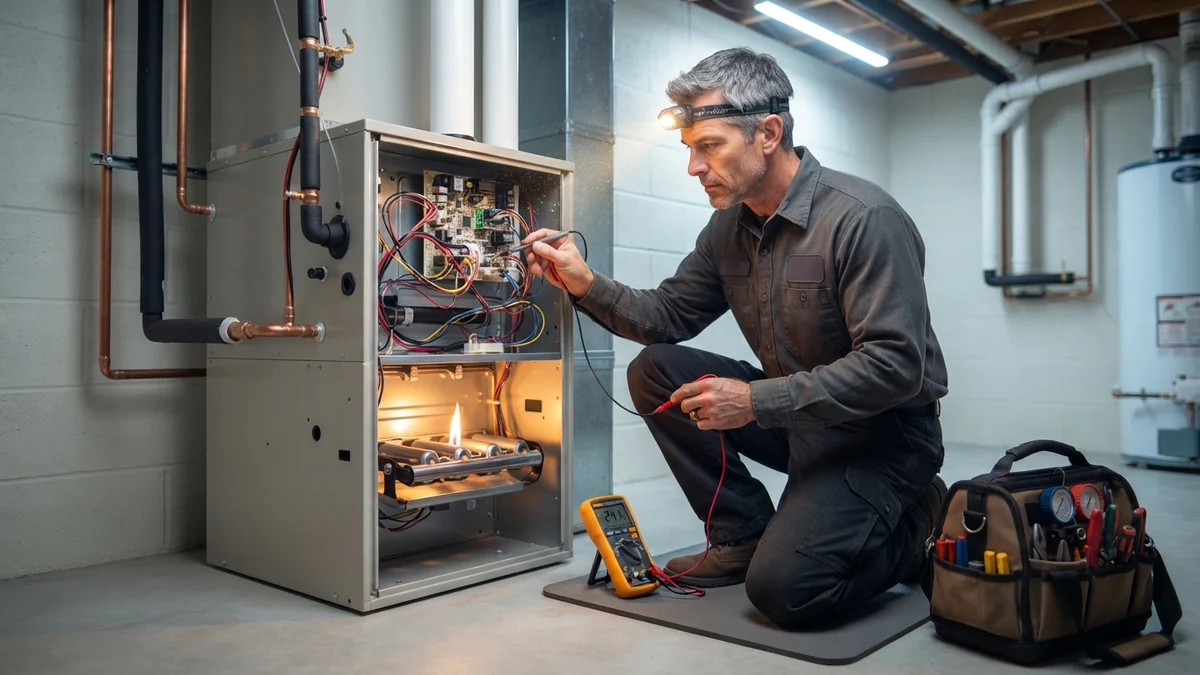
Dependable Furnace and Heating Repair in Topeka, Kansas
When winter cold fronts sweep across the Great Plains and sub-zero Arctic wind chills settle over Shawnee County, a dependable heating system is not a luxury—it is a critical life safety requirement. A furnace failure during a hard freeze exposes property owners to frozen plumbing pipes, severe water damage, and dangerous indoor temperatures. As part of our comprehensive residential and commercial HVAC services, our field network delivers rapid diagnostic dispatch, carbon monoxide safety testing, and precision craftsmanship for all types of heating equipment across Topeka, Silver Lake, Auburn, and Tecumseh.
Natural gas furnaces, electric air handlers, and dual-fuel heating systems rely on intricate sequences of electrical relays, safety limit switches, and combustion drafting controls. When a furnace begins short-cycling, clicking repeatedly without igniting, or blowing cold air across living areas, running the system repeatedly can crack the heat exchanger or trip high-voltage circuit breakers. Our professional technicians arrive equipped with advanced combustion analyzers, digital manometers, and common OEM replacement parts to diagnose and resolve heating faults safely and accurately.
Whether you reside in an established Craftsman bungalow in College Hill or a modern home in Westboro, our local dispatch coordinator connects you directly with technicians trained to handle all major furnace brands and configurations.
Common Heating and Furnace Failure Symptoms
Modern furnaces are engineered with multi-layered safety controls designed to lock the system down whenever operational parameters deviate from safe baselines. Recognizing these symptoms allows property owners to request professional assistance before a minor component fault leaves a home without heat:
1. The Furnace Blows Cold or Tepid Air
If the blower motor runs continuously but registers discharge cold air, the heating sequence has failed. This commonly occurs when a hot surface igniter cracks, a flame sensor becomes coated in silica and carbon oxidation, or the furnace has entered an automated high-temperature lockout due to a severely clogged air filter. Review our detailed troubleshooting guide on furnaces blowing cold air to understand basic diagnostic steps.
2. Repeated Clicking Sounds Without Burner Ignition
When a call for heat occurs, you should hear the draft inducer motor start, followed a few seconds later by a soft clicking sound as the gas valve opens and the electronic igniter illuminates the burners. If you hear rapid, repeated clicking followed by silence and a diagnostic LED error code flashing on the control board, the furnace is attempting ignition and failing, triggering an automated safety shutdown.
3. Persistent Short-Cycling (Turning On and Off Frequently)
A healthy heating cycle typically lasts ten to twenty minutes, allowing the heat exchanger to reach steady-state thermal efficiency and evenly warm the structure. If your furnace runs for only one to three minutes before shutting down, it is likely tripping its high-limit switch. This indicates severe overheating caused by restricted airflow, a failing blower motor, or an improperly calibrated gas manifold pressure.
4. Blower Motor Squealing, Scraping, or Humming
Abnormal mechanical noises originating from the furnace cabinet demand immediate inspection:
- High-Pitched Squealing: Worn bearings within the draft inducer motor assembly or main squirrel-cage blower motor.
- Metal-on-Metal Scraping: A loose blower wheel that has shifted on its motor shaft, striking the metal housing.
- Loud Banging or Thumping Upon Ignition (Delayed Ignition): Occurs when gas accumulates in the combustion chamber before igniting violently, placing severe physical stress on the heat exchanger.
- Low Electrical Humming: A seized blower motor attempting to draw current through a defective run capacitor.
5. Yellow or Flickering Burner Flames
Natural gas flames should burn with a crisp, stable, bright blue cone. A yellow, lazy, or wavering flame indicates incomplete combustion, poor air-to-gas ratio, or a draft disturbance caused by a cracked heat exchanger. Incomplete combustion generates dangerous levels of carbon monoxide (CO), an odorless, colorless, and potentially lethal gas.
6. Water Leaking Around a High-Efficiency Condensing Furnace
High-efficiency furnaces (90 percent AFUE and higher) extract so much heat from combustion gases that water vapor condenses into liquid within a secondary heat exchanger. If the internal condensate collection trap, drain tubing, or neutralizer becomes clogged with acidic sediment, water backs up, tripping pressure switches and pooling across the mechanical room floor.
Comprehensive Furnace Diagnostic Protocol: Safety-First Testing
Combustion heating equipment requires rigorous diagnostic procedures to safeguard indoor air quality and structural safety. When our field technicians arrive at your Topeka home, they execute an empirical diagnostic sequence:
[Customer Symptom Review and Thermostat Call Verification]
                        │
                        ▼
[Draft Inducer Motor Draft and Negative Pressure Switch Test]
                        │
                        ▼
[Hot Surface Igniter Resistance (Ohms) & Electrical Check]
                        │
                        ▼
[Gas Manifold Pressure Calibration (Inches Water Column)]
                        │
                        ▼
[Flame Rectification Microamp Measurement]
                        │
                        ▼
[Borescope Heat Exchanger Inspection and Flue CO Analysis]
                        │
                        ▼
[Blower Motor Static Pressure and Temperature Rise Verification]
                        │
                        ▼
[Presentation of Itemized Written Repair Estimate]
Step 1: Draft Inducer and Flue Drafting Verification
The technician verifies that the draft inducer motor draws sufficient negative static draft pressure through the flue pipe. Using a digital dual-port manometer, we measure draft pressure across the safety pressure switch to confirm that exhaust gases and carbon monoxide are actively expelled from the building before the gas valve is permitted to open.
Step 2: Igniter and Flame Rectification Testing
- Igniter Resistance Testing: Technicians measure electrical resistance (Ohms) across the hot surface igniter using a digital multimeter. Igniters showing micro-fractures or out-of-spec resistance are replaced before they burn out completely.
- Flame Sensor Microamp Analysis: When gas ignites, the flame itself conducts a microscopic direct current (DC) electrical signal back to the control board, known as flame rectification. If the flame sensor is coated in oxidation, signal strength drops below 1.0 microamp, causing the control board to shut off the gas valve within four seconds. Technicians clean or replace the sensor and verify a robust 2.5 to 5.0 microamp signal.
Step 3: Gas Manifold Pressure Calibration
Natural gas supplied by Kansas Gas Service must be delivered to burner orifices at precise manifold pressures—typically 3.5 inches of water column (in. w.c.) for standard residential furnaces. Over-fired furnaces overheat heat exchangers and produce elevated carbon monoxide; under-fired furnaces experience condensation in non-condensing flues, causing severe acid corrosion. Technicians connect a digital manometer to the gas valve port and adjust the regulator to exact factory specifications.
Step 4: Electronic Heat Exchanger and Flue Gas Analysis
Using high-resolution articulating borescopes, technicians inspect the internal surfaces of the heat exchanger for metal fatigue, rust perforation, or cracked weld seams. An electronic combustion analyzer is placed inside the flue pipe to measure oxygen, carbon dioxide, stack temperature, and parts-per-million (PPM) of carbon monoxide, confirming complete, clean combustion.
Common Heating Components and Precision Field Repairs
Our service vehicles carry an extensive inventory of universal parts and OEM components, allowing most repairs to be completed on the same dispatch visit:
| Malfunctioning Component | Failure Mode and Symptoms | Professional Remediation Protocol |
|---|---|---|
| Hot Surface Igniter (HSI) | Furnace clicks, inducer runs, but igniter does not glow; no flame ignition | Testing electrical voltage from board, replacing failed silicon carbide igniter with durable silicon nitride OEM element |
| Flame Rectification Sensor | Burners ignite for 3 to 5 seconds, then extinguish; cycle repeats three times before lockout | Removing sensor, polishing probe with non-abrasive steel wool, or installing replacement OEM sensor probe |
| Draft Inducer Assembly | Screeching noise on call for heat; pressure switch fails to close; furnace will not ignite | Removing housing, clearing flue obstructions, replacing failed inducer motor assembly and high-temperature gasket |
| High-Limit Safety Switch | Furnace overheats and cuts off burners; blower fan continues running indefinitely | Measuring airflow temperature rise across plenum; replacing defective bimetal high-limit switch after restoring proper duct airflow |
| Blower Run Capacitor | Blower motor hums loudly, fails to circulate air; furnace overheats rapidly on limit switch | Testing capacitor microfarad capacitance; replacing degraded capacitor with rated high-temperature OEM unit |
| Condensate Trap and Drain | High-efficiency 90%+ furnace shuts down with pressure switch code; water pools near cabinet | Chemical flushing of condensate trap, replacing cracked vinyl tubing, clearing secondary drain lines |
Repair Versus Replacement: Navigating Furnace Economics
When an aging furnace experiences a major mechanical failure, property owners must evaluate whether continuing to repair the unit makes financial sense compared to investing in an energy-efficient modernization:
- The 5,000 Dollar Decision Metric: Multiply the age of your furnace (in years) by the total estimated repair cost (in dollars). If the calculation exceeds 5,000, replacing the system is generally the more sensible investment. For example, a 16-year-old furnace requiring a $600 inducer motor replacement yields an index of 9,600, indicating that replacement offers far superior long-term reliability.
- Cracked Heat Exchanger: If diagnostic testing reveals a cracked heat exchanger, the furnace must be shut down immediately due to carbon monoxide safety risks. Replacing a heat exchanger on an older furnace requires extensive labor and expensive parts. In nearly every instance, investing those funds toward a modern high-efficiency furnace or cold-climate heat pump provides a much higher return on investment.
- Efficiency Gains (80% vs 96% AFUE): If your current furnace is an older standard-efficiency model (80% AFUE or lower), 20 cents of every dollar spent on natural gas escapes out the chimney as waste heat. Modern condensing furnaces achieve 96 percent AFUE or higher, significantly reducing monthly winter heating bills.
Review our transparent furnace repair cost guide to examine local Topeka component pricing and diagnostic fee benchmarks.
Clean-Tech Protocols and Transparent Project Estimates
We know that inviting a service technician into your home during a winter heating emergency can be stressful. We ensure a respectful, transparent service experience:
Prior Written Authorization
Our technicians will never perform work without your explicit prior authorization. Once diagnostic testing reveals the root failure cause, you receive an itemized, clear project estimate detailing parts, labor hours, and total cost. What you approve is what you pay—no surprise add-on charges or unverified fees.
Clean-Tech Property Protection
We treat your property with the utmost care. Before entering your home, technicians slip on sanitized protective shoe covers. Heavy canvas drop cloths are positioned beneath indoor air handlers and furnace work areas. When work is completed, technicians vacuum the workspace, remove all spent parts and packaging, and provide complete documentation for your records.
Connecting Furnace Health With Whole-Home Comfort
A furnace is an integrated part of your property's broader mechanical ecosystem:
- Keep your heating system operating at peak performance with annual multi-point inspections through our HVAC maintenance and tune-up program.
- In mild winter weather, discover how heat pump services and dual-fuel systems deliver superior energy efficiency.
- Prevent dry winter air, static shocks, and throat irritation by pairing your furnace with whole-home humidification through our indoor air quality solutions.
- Balance airflow to drafty rooms by inspecting and sealing ductwork with our ductwork repair and cleaning services.
- When severe winter freezes threaten household plumbing, utilize our priority emergency HVAC dispatch.
We proudly provide prompt local dispatch across all Shawnee County jurisdictions, including municipal hubs like Silver Lake, Auburn, Tecumseh, and neighborhood communities such as Potwin Place and Sherwood Lake.
Frequently Asked Questions About Furnace Repair in Topeka
How quickly can a technician be dispatched for a furnace repair?
Our local Topeka dispatch desk coordinates field technicians throughout Shawnee County. During extreme winter weather and freezing temperatures, high-urgency heating outages are prioritized, with technicians typically arriving promptly within agreed appointment windows.
Why is my furnace blowing cold air?
A furnace blowing cold air typically indicates that the blower fan is running while the burners have failed to ignite. Common causes include a dirty flame sensor, a cracked hot surface igniter, a tripped high-limit switch due to a clogged filter, or an open safety pressure switch.
What should I do if I smell gas near my furnace?
If you smell a strong natural gas odor (rotten eggs), evacuate all occupants and pets from the home immediately. Do not operate light switches, phones, or appliances inside the house. Call Kansas Gas Service or dial 911 from a safe distance outside.
How often should my furnace be serviced in Topeka?
Furnaces should receive a comprehensive professional tune-up and safety inspection once per year, ideally in early autumn prior to the heating season. Annual maintenance verifies carbon monoxide safety, cleans combustion sensors, and prevents sudden winter breakdowns.
Schedule Professional Furnace Repair in Topeka Today
Do not let a heating breakdown put your family's comfort and safety at risk this winter. Contact our experienced dispatch team today at (785) 219-8054 or submit an online service request through our contact page. We deliver prompt local dispatch, clear project estimates, and clean-tech craftsmanship across Topeka, KS.
Mandatory Pricing Disclosure: Estimates are for budgeting purposes only. Actual prices vary based on on-site equipment conditions, ductwork configuration, electrical compatibility, and mechanical permit fees required by the City of Topeka.
Direct Field Dispatch
Need immediate diagnostic assessment or repair scheduling?
Complementary HVAC Services
Our 4-Step Service Methodology
Engineered to guarantee punctuality, upfront cost clarity, and City of Topeka mechanical code compliance.
Discovery and Dispatch
Direct telephone intake with our Topeka dispatch coordinator to document failure symptoms, evaluate weather safety risks, and route the nearest field unit.
Empirical Diagnostic
Comprehensive physical, thermal, and electrical diagnostic testing of coils, motors, capacitors, and gas valves to pinpoint root failures without guesswork.
Clear Upfront Estimate
We explain exact component failure findings and present an itemized written estimate detailing scope and materials for your authorization before work starts.
Precision Execution
Precision repairs using OEM-spec parts, adherence to local Kansas mechanical codes, complete clean-tech vacuum cleanup, and operational clearance sign-off.
Frequently Asked Questions
Clear, factual answers regarding diagnostic procedures, pricing transparency, permits, and equipment performance in Topeka, KS.
How quickly can an HVAC technician be dispatched to my property in Topeka?
Do you provide written estimates before beginning repair work?
What clean-tech property protections do your technicians follow?
Are permits required for HVAC replacement in Topeka, KS?
What is the difference between SEER and SEER2 ratings in Kansas?
Should I repair or replace my aging central air conditioner or furnace?
How do extreme Kansas winter seasons affect heat pump performance?
Do you service both residential and commercial HVAC systems in Shawnee County?
Topeka and Shawnee County Service Radius
Providing direct technician dispatch across regional cities, historic neighborhoods, and rural acreage communities.