Ductwork Repair and Cleaning in Topeka, KS
Supply and return duct sealing, static pressure balancing, plenum repairs, and airflow restoration to eliminate hot and cold spots across Shawnee County.
Key Service Takeaways • Ductwork Repair and Cleaning
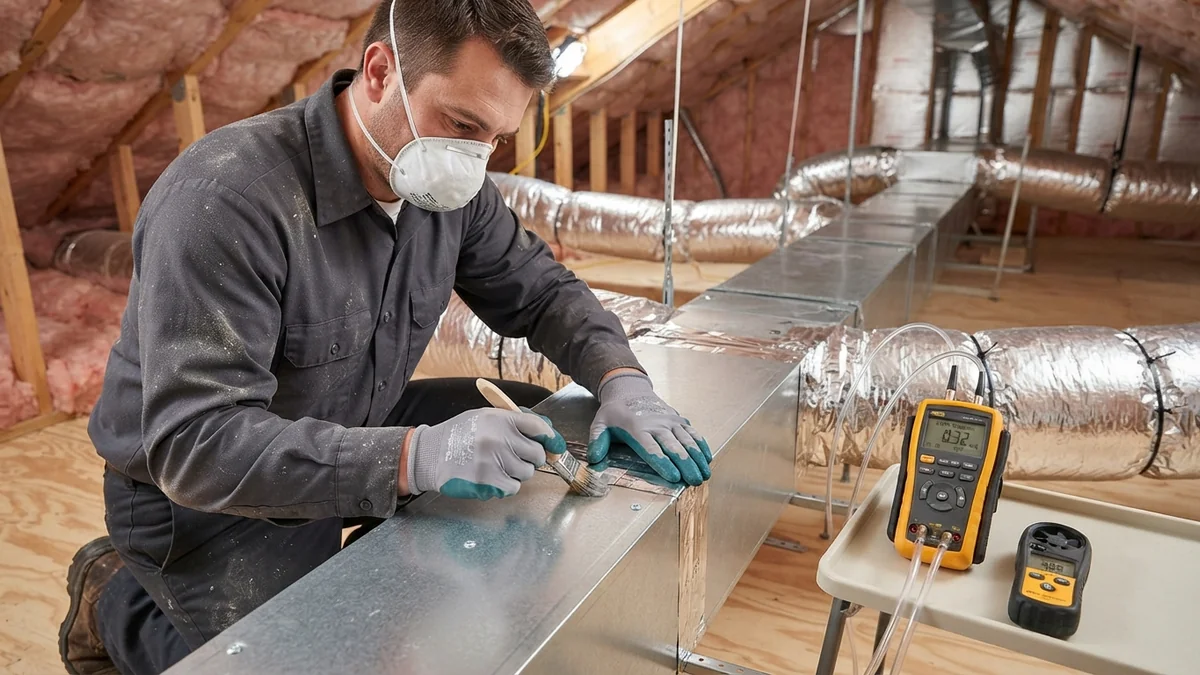
Precision Ductwork Repair, Sealing, and Cleaning in Topeka, KS
The ductwork distribution system represents the circulatory network of your home's heating and cooling infrastructure. You can invest in the most advanced 20 SEER2 condensing unit and 98 percent AFUE variable-speed gas furnace, but if your ductwork is undersized, poorly routed, leaking conditioned air into unconditioned attics, or choked with decades of accumulated debris, your comfort will remain compromised and your utility bills will soar. In Topeka, Kansas, where homes range from late-nineteenth-century historic residences with retrofitted sheet metal to sprawling mid-century suburban ranches with extended duct runs, ductwork deficiencies represent the single greatest cause of uneven room temperatures and premature equipment failure. As part of our comprehensive residential and commercial HVAC services, our field network delivers empirical static pressure testing, precision mastic sealing, custom sheet metal plenum fabrication, and specialized duct cleaning across Shawnee County.
Independent research by the Department of Energy confirms that the typical American home loses between 20 and 30 percent of its conditioned air through leaks, gaps, and disconnected joints in the duct system. In unconditioned attics where summer temperatures regularly exceed 130 degrees Fahrenheit, leaking supply ducts dump expensive chilled air into the attic while negative pressure in return ducts draws superheated, fiberglass-laden attic air straight into your living spaces. Our professional technicians utilize digital manometers, thermal imaging cameras, and flow hoods to measure actual cubic feet per minute (CFM) air delivery, sealing leaks and re-engineering duct bottlenecks to restore balanced comfort.
Whether your property is located in the historic avenues of Potwin Place or within lakefront homes in Sherwood Lake, our local dispatch coordinator connects you directly with technicians equipped to optimize your duct system with transparent pricing and clean-tech craftsmanship.
Warning Signs That Your Ductwork Requires Professional Attention
Ductwork problems are often hidden behind drywall, beneath floor joists, or inside dusty attic crawlspaces. Recognizing these behavioral symptoms helps property owners identify distribution faults before blower motors overheat:
1. Persistent Hot and Cold Rooms Across the Home
If your master bedroom remains sweltering in July while the living room is ice cold, or if drafty corner rooms never warm up during January freezes, your duct system is suffering from severe airflow imbalance. This indicates undersized branch runouts, disconnected flex ducts in attic spaces, or an imbalanced supply-to-return ratio that starves distant rooms of conditioned air.
2. Excessive Dust and Respiratory Irritation Indoors
If you dust your furniture only to see a fine layer of gray particulate resettle within twenty-four hours, your return ductwork is likely unsealed. Return ducts located in basements, crawlspaces, and attics operate under negative pressure. Leaks in these ducts act like giant vacuum cleaners, pulling pulverized fiberglass insulation, sheetrock dust, and fungal spores directly into the HVAC airstream and circulating them throughout your home. Review our complementary indoor air quality solutions to address airborne allergens.
3. Abrupt Spikes in Monthly Energy Bills
When 25 percent of the air heated by your furnace or chilled by your air conditioner escapes through unsealed joints before reaching living rooms, your system must run 25 to 40 percent longer to satisfy thermostat setpoints. This directly inflates electric bills from Evergy and natural gas charges from Kansas Gas Service.
4. Rattling, Whistling, or Popping Sheet Metal Sounds
Unusual acoustic noises from your walls and floors indicate aerodynamic restrictions:
- High-Pitched Whistling: High static pressure forcing air through an undersized register or an air leak in a return drop.
- Loud Popping or "Oil-Canning" Thuds: Occurs when thin-gauge sheet metal ducts expand or flex outward when the high-velocity blower motor starts, signaling insufficient metal gauge thickness or restricted return airflow.
- Vibrational Rattling: Loose duct hangers, unfastened slip-and-drive cleats, or branches rubbing against wooden floor joists.
5. Musty, Mildewed Odors When the Blower Cycles On
If the airflow from registers smells damp, stale, or moldy, moisture is condensing inside the ductwork. In humid Kansas summers, poorly insulated cold supply ducts sweating in hot attics promote rapid biological growth along internal fiberglass insulation linings.
Comprehensive Duct Diagnostic Methodology: Airflow Engineering in Practice
We reject guesswork and random dampers adjustments. When our technicians evaluate a duct system in Topeka, they execute an empirical airflow audit:
[Customer Comfort Survey and Temperature Mapping]
                      │
                      ▼
[Total External Static Pressure (TESP) Measurement]
                      │
                      ▼
[Thermal Infrared Duct Leakage Imaging]
                      │
                      ▼
[Airflow CFM Hood Balancing at Every Register]
                      │
                      ▼
[Borescope Internal Duct and Plenum Inspection]
                      │
                      ▼
[Itemized Written Repair or Sealing Estimate]
Step 1: Total External Static Pressure (TESP) Testing
Static pressure is the resistance to airflow inside a duct system—comparable to blood pressure in the human body. Using a dual-port digital manometer equipped with static pressure probes inserted into the supply and return plenums, technicians measure TESP in inches of water column (in. w.c.). Standard residential systems are engineered to operate between 0.50 and 0.80 in. w.c. Readings above 0.85 in. w.c. confirm severe airflow restriction that will cause air conditioning coils to freeze and furnace heat exchangers to overheat.
Step 2: Thermal Infrared Duct Leak Detection
Using high-resolution FLIR thermal imaging cameras while the heating or cooling system runs, technicians scan attic and crawlspace duct runs. Temperature differentials immediately illuminate hidden duct disconnects, torn flex outer jackets, and unsealed boot transitions behind floor joists.
Step 3: Register CFM Flow Hood Measurement
Technicians measure the actual volume of conditioned air discharging from every supply register using a calibrated digital balometer flow hood. Comparing measured CFM values against room-by-room ACCA Manual J load calculations reveals exactly which rooms are airflow-starved and which are over-conditioned.
Technical Comparison of Duct Repair and Sealing Solutions
| Remediation Methodology | Best Suited Application | Performance Benefit | Durability Lifespan |
|---|---|---|---|
| Mastic Paste and Mesh Tape Sealing | Accessible sheet metal plenums, main trunk lines, and boots | Forms an airtight, permanent elastomeric seal that flexes with metal expansion; zero drying cracks | 20+ Years |
| Aeroseal Internal Aerosol Sealing | Inaccessible ducts hidden inside finished drywall, interstitial ceilings | Aerosolized vinyl polymer particles seal leaks up to 5/8" from the inside out; reduces leakage to under 3% | 15 to 25 Years |
| Custom Sheet Metal Transition Redesign | Restricted plenums, choked equipment transitions, undersized return drops | Smooths turbulent air transitions, lowers static pressure by up to 0.30 in. w.c., restores proper CFM | Lifetime of Structure |
| R-8 Duct Insulation Re-Wrap | Exposed supply ducts in unconditioned Kansas attics and crawlspaces | Eliminates summer condensation sweating, prevents thermal heat gain/loss through metal walls | 15 to 20 Years |
| Rotary Brush Vacuum Duct Cleaning | Ducts with heavy post-construction dust, pet dander, or mold spore buildup | Removes physical particulate down to the bare sheet metal using negative air HEPA extraction | 3 to 5 Years Between Cleans |
Why Cheap Duct Tape Always Fails: The Mastic Standard
A widespread misconception among homeowners is that standard metallic or fabric "duct tape" is suitable for sealing air ducts. In reality, standard duct tape utilizes a rubber-based adhesive that dries out, turns brittle, and falls away within two to three years under the thermal cycling of heating and cooling systems.
Our technicians exclusively utilize fiber-reinforced water-based mastic paste applied with fiberglass mesh scrim tape. Mastic paste cures into an exceptionally durable, flexible rubberized membrane that adheres permanently to galvanized steel, aluminum, and flex collars. Mastic seals will never dry out, peel, or degrade under extreme attic heat or sub-zero winter temperatures, guaranteeing permanent airtightness.
Custom Sheet Metal Plenum Fabrication
In many older Topeka homes, previous contractors forced modern high-tonnage equipment onto legacy undersized sheet metal plenums. This creates severe aerodynamic turbulence directly above the indoor coil, choking airflow.
Our sheet metal specialists fabricate custom galvanized metal transitions with aerodynamic radius elbows and turning vanes:
- Return Drop Expansions: Expanding restrictive 16-inch return drops into full-capacity 10x24-inch or 10x26-inch transitions equipped with 4-inch media filter cabinets.
- Supply Plenum Redesign: Designing graduated supply plenums that maintain consistent static pressure from the first branch runout to the end cap, ensuring equal airflow delivery to both near and distant rooms.
Professional Duct Cleaning: Clean Air From the Inside Out
Over years of living in a home, dust, pet dander, pollen, carpet fibers, and renovation debris settle inside supply and return trunks. When high humidity occurs, this organic dust provides nutrients for microbial growth.
Our professional duct cleaning protocol utilizes truck-mounted or portable high-vacuum negative air machines paired with motorized rotary brushes:
- The duct system is placed under continuous negative static pressure using high-efficiency HEPA extraction equipment.
- Motorized rotating nylon brushes are guided down every branch run, dislodging compacted dust, pet hair, and debris from duct walls.
- High-velocity compressed air whips blast remaining particulate toward the negative air vacuum, removing it entirely from your home without releasing dust into living spaces.
- Supply registers and return grilles are washed and sanitized before reinstallation.
Clean-Tech Protocols and Transparent Project Estimates
We approach ductwork services with strict property protection:
- Protective Floor Runners: Canvas tarps protect all flooring from entryway to attic access panels.
- Sanitized Protective Shoe Covers: Technicians slip on clean covers before entering your home.
- Clear Project Estimates: Prior to performing duct modifications, you receive an itemized written estimate detailing scope, materials, and total investment. What you approve is what you pay—with zero unexpected charges.
Connecting Ductwork Health With Overall System Performance
Your ductwork directly determines the efficiency and lifespan of your primary heating and cooling equipment:
- Restricted ductwork causes compressors to overheat; protect your cooling equipment with professional air conditioning repair and HVAC maintenance.
- If you are planning an equipment upgrade, ensure your ducts are matched to modern SEER2 standards with our AC installation and replacement program.
- Prevent high-limit furnace cycling during winter freezes with furnace and heating repair services.
- Explore all-season energy savings through advanced heat pump services.
- In high-urgency freeze or breakdown scenarios, rely on our priority emergency HVAC dispatch.
We proudly provide ductwork repair and cleaning services across Shawnee County, including Silver Lake, Auburn, Tecumseh, and neighborhood communities such as College Hill and Westboro.
Frequently Asked Questions About Ductwork in Topeka
How do I know if my ductwork is leaking air into my attic?
Common signs include uneven room temperatures, excessive dust throughout the house, soaring monthly electric and gas bills, and a noticeable drop in airflow discharging from registers. A professional thermal imaging inspection can verify exact leak locations.
How much can I save on utility bills by sealing my ductwork?
According to the Department of Energy, sealing leaky ductwork reduces heating and cooling energy consumption by 20 to 30 percent, delivering substantial savings on Evergy electric bills and Kansas Gas Service charges.
What is static pressure, and why does it matter?
Static pressure is the resistance to airflow within a duct system. When static pressure is too high (due to undersized ducts or clogged filters), the blower motor must work significantly harder, leading to motor burnout, frozen cooling coils, and noisy whistling registers.
How often should residential air ducts be professionally cleaned?
Most residential duct systems should be professionally cleaned every three to five years, or sooner if you have completed major home renovations, have multiple indoor pets, or have family members suffering from severe respiratory allergies.
Schedule Professional Ductwork Service in Topeka Today
Restore balanced airflow, eliminate hot and cold spots, and lower your monthly heating and cooling costs. Contact our experienced dispatch team today at (785) 219-8054 or submit an online request through our contact page. We deliver clear project estimates, precision static pressure balancing, and clean-tech craftsmanship across Topeka, KS.
Mandatory Pricing Disclosure: Estimates are for budgeting purposes only. Actual prices vary based on on-site equipment conditions, ductwork configuration, electrical compatibility, and mechanical permit fees required by the City of Topeka.
Direct Field Dispatch
Need immediate diagnostic assessment or repair scheduling?
Complementary HVAC Services
Our 4-Step Service Methodology
Engineered to guarantee punctuality, upfront cost clarity, and City of Topeka mechanical code compliance.
Discovery and Dispatch
Direct telephone intake with our Topeka dispatch coordinator to document failure symptoms, evaluate weather safety risks, and route the nearest field unit.
Empirical Diagnostic
Comprehensive physical, thermal, and electrical diagnostic testing of coils, motors, capacitors, and gas valves to pinpoint root failures without guesswork.
Clear Upfront Estimate
We explain exact component failure findings and present an itemized written estimate detailing scope and materials for your authorization before work starts.
Precision Execution
Precision repairs using OEM-spec parts, adherence to local Kansas mechanical codes, complete clean-tech vacuum cleanup, and operational clearance sign-off.
Frequently Asked Questions
Clear, factual answers regarding diagnostic procedures, pricing transparency, permits, and equipment performance in Topeka, KS.
How quickly can an HVAC technician be dispatched to my property in Topeka?
Do you provide written estimates before beginning repair work?
What clean-tech property protections do your technicians follow?
Are permits required for HVAC replacement in Topeka, KS?
What is the difference between SEER and SEER2 ratings in Kansas?
Should I repair or replace my aging central air conditioner or furnace?
How do extreme Kansas winter seasons affect heat pump performance?
Do you service both residential and commercial HVAC systems in Shawnee County?
Topeka and Shawnee County Service Radius
Providing direct technician dispatch across regional cities, historic neighborhoods, and rural acreage communities.